
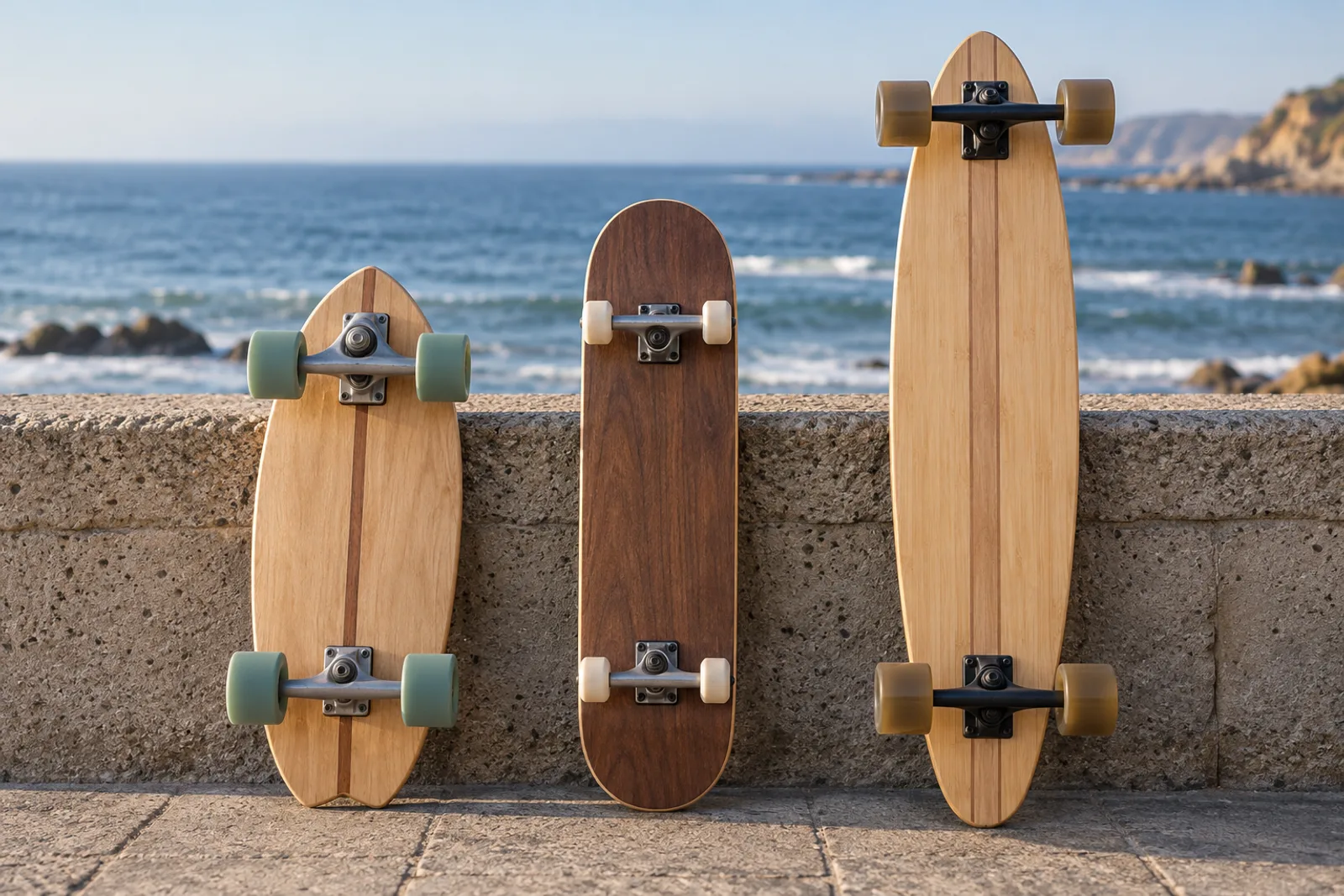
You have probably seen people making odd turns on boards that look like normal skateboards but move like surfboards on the street. That is a surfskate. Together with the classic skateboard, the cruiser and the longboard, that makes 4 categories that many people mix up. In this article we explain the differences and tell you which one fits what you want to do.
The 4 categories in one table
| Type | Board size | Trucks | Best for |
|---|---|---|---|
| Classic skateboard (popsicle) | 7.5″-8.5″ × 31-32″ | Standard | Tricks, street, park, bowl |
| Cruiser | 28-32″ × 8-10″ | Standard (high + soft wheels) | Getting around, commuting, short distances |
| Surfskate | 28-32″ × 9-10″ | Special (Carver, YOW…) | Simulating surf on the street, slalom, fitness |
| Longboard | 36-50″ × 9-10″ | Standard reverse | Long distances, downhill, dancing |
Classic skateboard (popsicle): the original skateboard
It is what you picture when you hear “skateboard”. A symmetrical board with kicktails at both ends, 7.5-8.5″ wide, with small hard wheels.
What it is for: tricks (ollies, flips, grinds, slides), skating parks, bowls, streets.
Who it is for: anyone who wants to learn to skate seriously. It is the most complete board in the sense that with a popsicle you can do any discipline.
Pros:
- Maximum versatility.
- A board you will always come back to.
- Huge community.
Cons:
- Not comfortable for long distances (it tires you out).
- You have to learn to move on it: pushing, braking, balancing.
Cruiser: the board for popping to the bakery
A cruiser is basically a classic skateboard with a slightly wider deck and, above all, big soft wheels (60-70mm, 78-87A). The soft wheels absorb the vibration from the asphalt and let you ride the street without every paving slab punishing you.
What it is for: short to medium distances (1-5 km), commuting, going to the café or the gym.
Who it is for: someone who already knows how to skate and wants something comfortable for every day. Or a beginner who only wants to get around and doesn’t care about tricks.
Pros:
- Comfortable on any urban surface.
- Quick setup from a popsicle deck: swap hard wheels for soft ones and you have “cruiser mode”.
- It doesn’t take much space.
Cons:
- Not suited to flips or, for the most part, grinds (soft wheels are too slow).
- More expensive than a normal skateboard because of the premium wheels.
Surfskate: surfing on the street
Here everything changes. The front truck is radically different from a normal skateboard: it pivots much more, which lets you make extreme turns just by leaning your body.
Reference brands: Carver (the American original), YOW (Spanish, very popular in Spain), SmoothStar (Australian), Slide (entry level).
What it is for:
- Simulating the movement of surfing on dry ground.
- Slalom and aggressive turns.
- Building speed just by pumping with your body (without touching the ground with your foot).
- Cross-training for surfers.
- Fitness.
Who it is for: surfers who live far from the sea, skaters looking for something new, people who want fun urban fitness.
Pros:
- An addictive “surfing” feel.
- No pushing required: you pump and move forward.
- It works your core and legs much more than a normal skateboard.
Cons:
- Not for tricks (the geometry prevents it).
- A steep learning curve in the first few days.
- More expensive than a classic skateboard (a surf truck alone costs 80-150€).
- There are 3 levels of “aggressiveness” (the Carver C7 is the most extreme, the Carver CX is more manageable, the YOW Meraki sits in the middle). If you go for the most extreme one straight away, you will get frustrated.
Longboard: the long-distance board
A LONG (90-130 cm) and wide board. Reverse kingpin trucks for more stability at speed. Big, soft wheels.
Subcategories:
- Cruising/transport longboard: spending the day skating around the city, along the seafront, etc.
- Downhill longboard: going down mountains at 60+ km/h. Only for people who know what they are doing.
- Longboard dancing: dancing or doing footwork on the board on flat ground. A beautiful style.
- Longboard freeride: controlled slides at medium speed.
What it is for: long distances, sustained speed, downhill, dancing.
Who it is for: people who want to cover 5-30 km in one go, surfers who want to go down mountains, board dancers.
Pros:
- Maximum stability at speed.
- Comfort over long distances.
- Disciplines like dancing are unique and beautiful.
Cons:
- It takes up a lot of space (it doesn’t fit in a backpack).
- Not for classic tricks.
- Downhill disciplines are dangerous if you don’t know what you are doing.
Which to choose for your goal
- I want to learn tricks → classic skateboard (popsicle).
- I want to get comfortably from work to home → cruiser.
- I want the feeling of surfing without the sea → surfskate.
- I want long distances / downhill / dancing → longboard.
If you are unsure and starting from zero: a classic popsicle. It gives you the most versatility and you can “evolve” from it in any direction.
Where to go next
- How to choose your first skateboard deck: the complete guide.
- How to ollie: the trick that opens up the classic skateboard.
- How much a complete skateboard costs: real budgets.
Frequently asked questions
What exactly is a surfskate?
A skateboard with a special front truck (Carver, YOW, SmoothStar...) that pivots much more than a normal one, imitating the feel of surfing a wave. It lets you build speed just by pumping with your body, without pushing with your foot on the ground.
Surfskate or longboard to start?
If you want technical slalom and surf-style turns, a surfskate. If you want relaxed kilometres, gentle downhill and long trips, a longboard. For absolute beginners with no clear goal, a surfskate is fun faster.
Can I learn to ollie on a surfskate?
No. The geometry of the surf truck makes the board unstable when you jump. If you want tricks, you need a classic skateboard (popsicle). On some premium surfskates you can swap the front truck for a regular one and turn it into a cruiser.
Yow vs Carver vs SmoothStar?
Carver is the American original (US): C7 and CX trucks, a long track record. YOW is Spanish: very popular in Spain, top value for money. SmoothStar is Australian: the most extreme surf simulation, recommended for skaters or surfers who already have experience.
How much does a decent surfskate cost?
Decent entry level: 150-200€ (Yow, Slide). Premium: 250-400€ (Carver C7, SmoothStar Holy Toledo). Below 150€, they are usually cruisers with a surfskate label and without the real geometry.
Conversation
Your name will be public. Your email stays private. Comments are reviewed before publishing.