
Choosing a deck seems more complicated than it is. There are sizes in inches, technology names in English and catalogues with hundreds of graphics, but what really changes how you skate comes down to three things: the width, the shape and the construction. Once those are clear, the brand and the graphic are decisions of taste and budget.
This guide goes from the general to the specific. First the short answer for anyone in a hurry, then each criterion on its own, then brands, technologies, profiles (beginner, street, park, city, kids, tall riders), the most typical mistakes and when it is time to replace your deck. If you only want to know what size you are, there is the skateboard deck size chart with centimetre equivalents.
Parts of the deck
Before talking about sizes it helps to put a name to each part of the deck, because in the rest of the guide (and in any product page) you are going to read things like “nose”, “concave” or “wheelbase”.
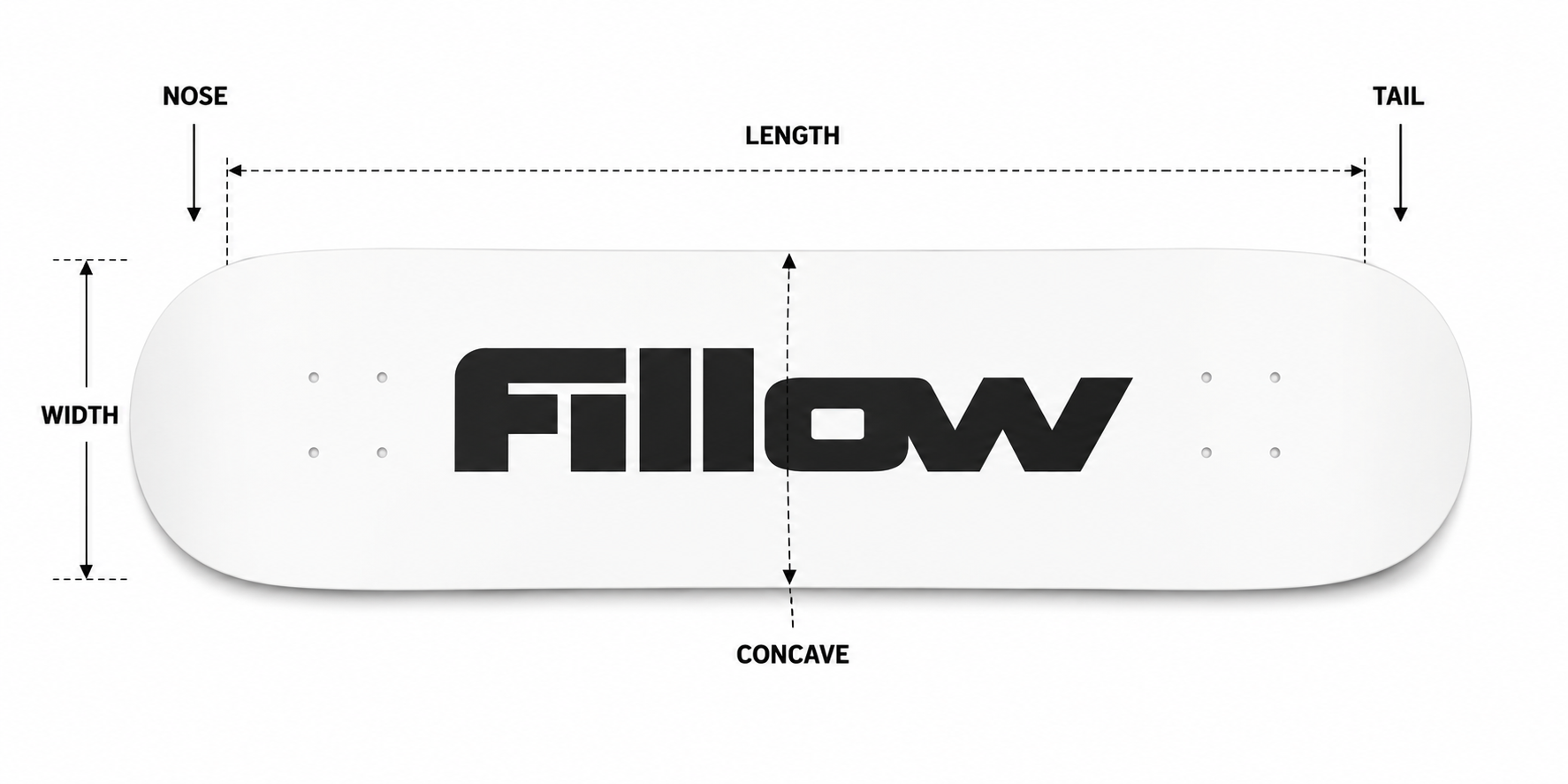
The sizes that change how you skate
The full size chart, with centimetre conversions and sizes for kids, is in skateboard deck size chart. Here we cover what each measurement means once you are standing on the board.
Width: the main decision
It is measured in inches and on standard decks it runs from 7.5″ to 8.5″. The most common are 7.75″, 8.0″, 8.125″, 8.25″ and 8.5″. Each quarter inch is about 6 mm, and you notice it more than you would think.
- Narrower (7.5″ to 7.875″): lighter to move, turns fast and works well for flips and technical street.
- Mid-width (8.0″ to 8.125″): the balance point. It is where almost everyone starts.
- Wider (8.25″ to 8.5″ or more): more stability and foot surface. It suits parks, bowls, ramps and tall people or those with big feet.
A rule of thumb many shops use: the width should match the foot. For a foot up to EU 41, around 7.75″ to 8.0″; for EU 42 to 44, 8.0″ to 8.25″; for EU 45 and up, 8.25″ to 8.5″. It is not a rule, it is a starting point to test.
Length: you almost never choose it
Standard decks are around 31″ to 32.5″ (79 to 82 cm). The difference between models is small and depends more on the manufacturer than on what you are after. What does vary a bit is the length on shaped decks or for very tall people. Width rules.
Concave: grip versus comfort
It is the cross-wise curve, what your foot feels when it rests on the board. More concave means more grip and an easier time landing a flip, in exchange for forgiving mistakes less. Less concave means more stability and comfort, but flips take a bit more effort.
| Concave | Foot grip | Best for |
|---|---|---|
| Low (mellow) | Low, flat feel | Rolling, ramps, bowls, long sessions |
| Medium | Balanced | Almost everything: street, park and first steps |
| High (steep) | High, the foot feels locked in | Technical street and fast flips |
If in doubt, medium. One detail that throws people off: “medium” is not a standard measurement. Two decks that say medium can feel different depending on the brand, so the best thing is to try them in a shop if you can.
Wheelbase: the fine tuning
It is the distance between the two sets of truck holes. On standard decks it runs from 13.5″ to 15″. A short wheelbase gives turning and response; a long one gives stability and a wider turning radius. Most 8.0″ decks come with 14″ to 14.5″, and there is no need to touch anything until you know what you are missing.
Work out your approximate size
Enter three details and you get a starting point. To really fine-tune it, use the skateboard deck size calculator afterwards, which takes height, weight, foot, style and level into account.
The most popular all-rounder size. Works for street, park and bowl. When in doubt, this one.
Full calculatorIf you already know the width and want to see how it looks with compatible trucks and wheels, the skateboard builder puts the set together piece by piece.
Popsicle, shaped and cruiser: the shape of the deck
The shape decides what the deck is for. There are three families, and the choice is quick if you are clear about what you want to do.
Popsicle
Symmetrical, with raised nose and tail. Good for ollies, flips, switch and any trick. It is the shape of the vast majority of decks you will see in a skate shop.
Shaped / pool
Wider, with a wider nose and sometimes a more curved tail. Made for bowls, pools, ramps and parks, where stability is the goal. Less comfortable for technical flips.
Cruiser
Made for getting around. It usually has a flat nose and a small tail, and is often sold as a complete with soft wheels. Great for rolling, limited for tricks.
This is what usually happens with the “popsicle or cruiser?” question. If tricks are what attract you, start with a popsicle, because learning ollies on a cruiser is more awkward. If you want to get around town, a cruiser is more comfortable and easier to carry. And if you land in between, an 8.25″ popsicle with slightly softer wheels works for both, and you can move to another shape later at your own pace.
Materials and construction technologies
The vast majority of decks are maple, usually Canadian or North American, in 7 plies pressed with glue and laid cross-wise so the wood doesn’t split. On top of that base each brand adds its own variant, and that is where the tangle of acronyms appears.
This table sums up the families you will come across:
| Construction | What changes | Who it is for | Approx. extra cost |
|---|---|---|---|
| Standard 7-ply maple | The reference: decent pop, average weight, base price | Starting out and regular skating | None |
| Thinner plies (e.g. Featherlight) | Lighter with the same 7-ply structure | Anyone who notices the weight or skates technical | Low |
| Resin or epoxy with fibre (e.g. Flight) | Thinner, stiffer and keeps its pop for longer | Skating a lot and breaking or softening decks | Medium to high |
| Carbon inserts (e.g. Impact Light) | Reinforcement around the truck area and less weight | Intense street, tall or heavy riders | Medium |
| Nose and tail reinforcement (e.g. Powerply) | Plastic at the tips so they don’t chip | Anyone who wrecks the nose and tail quickly | Low to medium |
| Slick base (Everslick and similar) | A layer on the underside so the graphic lasts and slides better | Anyone doing slides and grinds on ledges | Low |
Two nuances that help you avoid overpaying. The acronyms vary from brand to brand and are not always equivalent, so look at what each technology does (thins, reinforces, protects) rather than the commercial name. And more plies does not mean a better deck: the standard is 7, and many shops are wary of 8 or 9 ply decks when they come without a known brand. For a more detailed guide to each technology, there is the one on deck technology and materials.
Skateboard deck brands: what is out there and how they differ
Good news here: almost any mid-range skate brand makes perfectly good decks. The most visible differences between them are the graphic, the pro models, the technology they highlight and the price. This is what usually sets the best-known ones apart:
| Brand | Defining trait | Usual profile |
|---|---|---|
| Element | Featherlight line of thinner plies and a wide range of sizes and completes | Beginners and intermediates, many sizes |
| Almost | Impact Light line with a carbon insert, plus standard decks | Street, intermediate to advanced |
| Powell Peralta | Flight construction, thin and reinforced with fibre and epoxy, and classic reissues | Those who skate a lot or want something more durable |
| Santa Cruz | Powerply on nose and tail and the VX line with composite layers, plus old school reissues | Skaters who break tips, classic style |
| Plan B | Mid-range maple decks with a very well-known pro team | Street and park, mid level |
| Toy Machine | Recognisable graphics and a stable mid-range | All levels |
| Baker | Classic skate culture brand with a maple range | Street and park |
| Anti-Hero | Classic skate culture brand with its own aesthetic | Street with character |
| Polar | Artist graphics and a varied size catalogue | Street and park |
| Girl | Pop Secret line with a carbon layer and thin plies | Technical street |
| Real | Maple decks with several constructions depending on the model | Street and park |
Other very common brands in skate shops, like Enjoi, Habitat, Globe or Birdhouse, meet the same criteria: 7-ply maple, mid-range and a good spread of sizes. There are also shop own-brand decks, which are often a very valid option if you want to save money without giving up good wood.
When two decks meet what you need, pick the graphic you like most or the brand you identify with. Skateboarding is also identity, and liking what you ride makes you skate more.
Quality and price: what to buy without overpaying
Without going into a specific model, these are the price ranges you will see for a deck on its own, from cheapest to most expensive:
| Tier | Approx. price (deck only) | What it usually is |
|---|---|---|
| Shop brand or blank | 35 to 55 € | Maple with no pro model attached, no artist graphic; sometimes the best value |
| Mid-range | 50 to 80 € | Known skate brands, 7-ply maple, pro graphic |
| Technology (fibres, resins, carbon) | 70 to 100 € or a bit more | The same base with reinforcements so it lasts longer |
| Reissues and special editions | 100 € and up | Collecting, classic shapes or small production runs |
The most balanced value is usually in the mid-range and in blanks. A blank is a deck without a flashy graphic, normally from a recognised skate brand, that lowers the price because it doesn’t pay for the image of a professional skater.
Five signs a deck is the real thing
- It says maple and 7 plies on the product page. If the wood isn’t stated, be wary.
- The brand belongs to skate culture, with riders, videos and a real presence in specialist shops.
- The concave is even and the deck has no warping when you rest it on its edge on a flat surface.
- The weight is reasonable: a real skateboard deck feels more solid than a toy one.
- The price is realistic. A branded skate deck far below the normal range for its tier is usually an old model on sale or a blank. If it drops a lot and the brand is not a skate brand, be suspicious.
Deck on its own or complete skateboard
- Complete (deck, trucks, wheels, bearings and grip tape assembled): the most convenient way to start and the cheapest as a set. Those from skate brands usually run between 80 and 120 €. Normally the first parts you replace will be the wheels and bearings, not the deck.
- Deck on its own: the option if you already know which trucks and wheels you want. It comes to a similar total price, but with better average quality in each part. We explain how to put it together in build a complete skateboard step by step.
Which deck to choose for your profile
Beginner
- Width: 7.875″ to 8.125″, with 8.0″ as the centre.
- Shape: popsicle.
- Construction: standard 7-ply maple.
- Concave: medium.
- What to buy: a complete from a skate brand or a mid-range loose deck, with trucks and wheels from a recognised brand.
The key when starting is not to struggle with the gear: a reasonable-quality deck avoids the frustration of thinking you are failing when the equipment is. That doesn’t mean spending more, it means choosing well within a sensible range.
Street and technical
- Width: 7.75″ to 8.25″.
- Concave: medium to high.
- Construction: 7-ply maple or thinner, reinforced variants if you skate many times a week.
In technical street the deck takes a beating: falls onto kerbs, constant flips and tails that wear down. Here it does make sense to consider a reinforcement technology, because it pays for itself if it saves you one deck out of every two or three.
Park, ramp and bowl
- Width: 8.25″ to 8.5″, or shaped from 8.5″ up.
- Concave: low to medium.
- Wheelbase: slightly long, 14.5″ to 15″.
For transition you look for stability at speed and comfort in long sessions. A gentle concave helps your foot not catch on every curve.
Getting around town
- Option 1: a cruiser or a shaped deck, more comfortable for getting around and for carrying under your arm.
- Option 2: an 8.25″ popsicle with softer, bigger wheels, if you also want to learn tricks.
If your main use is getting around, comfort and stability come first, not technique.
Kids
For the youngest there are decks from 6.5″ up to 7.5″, with adapted proportions. The most practical thing is to look at height and age in the deck size guide. A kid who already wears an EU 38 or 39 and is over 1.50 m (4’11”) can usually move up to an adult 7.5″ to 7.75″ deck without a problem.
Tall or heavy riders
- Width: 8.25″ to 8.5″.
- Construction: consider a deck with fibre or carbon reinforcement if you see yourself breaking decks, especially if you don’t always land on the trucks.
- Another point: a slightly wider pair of trucks to go with the width of the deck (see truck sizes).
Women
There is no such thing as a “women’s” deck. The criteria are the same as for anyone: foot, height, style and level. It is normal to sit between 7.75″ and 8.25″.
Deck shortlist for starting out and levelling up
Prices change through the year, so we don’t give exact figures; the ranges are in the quality and price section. These are real options for each profile. The links take you to a search with the size already set, so you can filter by graphic.
For starting out or everyday use
- All-round Element Featherlight 8.0 Light 7-ply maple, the starting width for almost everyone and a very wide range of graphics. Delivers in street, park and on the road.See on Amazon
- Street Almost Impact Light 8.0 It has a carbon insert over 7 plies of maple. A step above the basic deck if you already skate several times a week.See on Amazon
- Classic Santa Cruz Screaming Hand 8.0 A historic graphic on 7-ply maple. For anyone who wants a deck with identity without leaving the mid-range.See on Amazon
- Technical Girl Pop Secret 8.0 Thin plies with a carbon layer. Made for technical street and for anyone who notices the weight of the deck.See on Amazon
- All set up Element complete skateboard 8.0 If you don't want to pick parts, a complete from a skate brand with a starting width gets you skating the same day.See on Amazon
Affiliate links: if you buy, Fillow earns a small commission at no extra cost to you. We pick products for what they are, not for the commission.
For skating a lot and lasting longer
- Durable Powell Peralta Flight 8.25 Thin construction reinforced with fibre and epoxy. It is the reference if you wreck a deck every few weeks.See on Amazon
- Tough Almost Impact 8.25 Carbon inserts over the truck areas. Good for tall or heavy riders who break decks often.See on Amazon
- Pro Santa Cruz VX 8.25 Composite layers between the maple ones to add stiffness and life to the deck. Good for park and for demanding street.See on Amazon
- Wide Powell Peralta Flight 8.5 The same Flight construction in an 8.5 width, for park and bowl or for anyone with a big foot.See on Amazon
Affiliate links: if you buy, Fillow earns a small commission at no extra cost to you. We pick products for what they are, not for the commission.
Typical mistakes when choosing a deck
- Buying the cheapest in the catalogue. If it is from a toy shop or supermarket, the material is usually worse, the trucks jam and the deck makes you blame yourself for things that aren’t your fault. A mid-range skate brand deck costs only a little more and you notice it from day one.
- Going only by the graphic. If two decks meet the width and construction, pick the one you like most; but don’t sacrifice the right width for a design.
- Choosing a width because it’s trendy. Wide decks are everywhere, but if your foot and style call for 8.0 there is no reason to go to an 8.5.
- Changing deck after every bad session. The deck is rarely the problem. Give a size at least a few weeks before jumping to another.
- Paying for technology you don’t need. Fibres and resins pay off if you break or soften decks often, not if you skate a couple of times a month.
- Forgetting the rest of the set. A good deck with poor-quality trucks and wheels performs badly. Also take care over choosing trucks and wheels, and make sure the truck width matches the deck.
- Not wearing protection. A helmet when starting or if you go to parks and bowls, and elbow pads or wrist guards if falling is hard for you. They are not for wimps, they are for keeping on skating.
How long a deck lasts and when to replace it
Lifespan depends more on you than on the deck. A street skater who goes out several times a week can replace it in one to three months; someone who skates regularly and moderately, between three and six; and in parks, bowls or cruising it can reach a year or more.
| Use | Approx. lifespan |
|---|---|
| Intense street (several sessions a week) | 1 to 3 months |
| Regular street or park use | 3 to 6 months |
| Gentle park, bowl or rolling around town | 6 to 12 months or more |
Signs it is time to replace it
- The pop has gone: the ollie no longer responds like before even when you do it right.
- Rounded or chipped nose or tail: without a tip there is no pop and the risk goes up.
- Cracks next to the bolts or the wood open at a tip: it can snap under your foot.
- Visible warping: when the deck loses its shape, it no longer sits right.
What wears it out sooner
Water is the main enemy: skating in the wet or leaving the deck on wet ground swells the wood and kills the pop. Extreme heat doesn’t suit it either, such as leaving it for hours in a car in the sun. Store it with the grip tape facing up or lying flat, not on its edge, and don’t overtighten the bolts.
Quick glossary
- Ply: each layer of wood. The standard is 7.
- Pop: the deck’s ability to jump when you press the tail.
- Concave: the cross-wise curve of the deck.
- Kicktail: the upward angle of the nose and tail.
- Wheelbase: distance between the two sets of truck holes.
- Blank: a deck without an artist graphic, normally from a known brand and at a reduced price.
- Shaped: a deck with a shape different from the popsicle, wider at the nose and made for transition.
- Pro model: a deck with the graphic and shape of a specific professional skater.
So what now?
With the deck chosen, these are the parts you still have to sort out:
- Skateboard deck size calculator to fine-tune the width for your height, weight, foot and style.
- Skateboard builder to put the set together with compatible trucks and wheels.
- How to choose trucks and how to choose wheels to complete the build.
- Build a complete skateboard step by step if you are going to assemble it yourself.
If you have questions this guide doesn’t answer, write to us through contact.
Ready to buy?
If you want to skip the back-and-forth, here are two clear paths. If you'd rather fine-tune, head back to the sections above.
Frequently asked questions
What skateboard deck should I buy for my first board?
A 7-ply maple popsicle, around 8.0 inches wide with medium concave, from a proper skate brand. It is the most versatile setup and the one that holds you back the least while you learn. If you don't want to pick parts, a complete skateboard built with those specs saves you the work.
What deck size do I need for my height and shoe size?
As a starting point, between 7.75 and 8.0 inches if you are under 1.70 m (5'7") or wear up to a EU 41 (US 8), between 8.0 and 8.25 if you are in the middle, and 8.25 or more if you are over 1.85 m (6'1") or wear a EU 44 (US 10.5) or bigger. It is a guide: style and feel matter as much as the numbers. The size chart and the calculator help you fine-tune it.
What is the difference between an 8.0 and an 8.25 deck?
It is 6 millimetres of width, but you notice it. The 8.0 turns sooner and feels lighter for flips and technical street. The 8.25 gives your feet more surface and more stability in parks, bowls and at speed. If you skate a bit of everything and you are unsure, the 8.0 is the safe bet.
How much does a good skateboard deck cost?
A deck on its own from a skate brand usually runs between 50 and 80 euros. Those with special fibres or resins cost between 70 and 100 euros or a bit more. A decent complete to start with is around 80-120 euros. Below that, especially if it is not a skate brand, quality tends to suffer.
Is a carbon fibre or resin deck worth it?
If you skate several times a week and break or soften decks often, yes: they last longer and keep their pop for longer. If you are starting out or skate casually, a good 7-ply maple deck performs just as well for you and costs a lot less. It is wise to wait until you know how much you skate before paying the extra.
How long does a skateboard deck last?
It depends on how much and where you skate. In intense street it can last 1 to 3 months, in regular street use 3 to 6, and in parks, bowls or cruising it can reach a year or more. The signs it is time to replace it are that the pop is gone, the nose and tail are rounded or chipped, and cracks appear next to the bolts.
Is it better to buy a deck on its own or a complete skateboard?
To start, a complete from a skate brand is more convenient and you don't have to worry about compatibility. If you already know which trucks and wheels you want, a loose deck lets you build it your way. With a complete, it is normal to swap the wheels, bearings or trucks over time; the deck is usually the last thing you replace because of quality.
What is the difference between a popsicle and a cruiser?
The popsicle is symmetrical, with raised nose and tail, and is made for ollies, flips and tricks of all kinds. The cruiser usually has a wider shape and often a flat nose, and is made for getting around comfortably. If you want to learn tricks, go popsicle; if you only want to get around, a cruiser makes it easier.
What is concave and which one suits me?
It is the cross-wise curve of the deck. The more concave, the more grip and the easier flips become, but it forgives mistakes less; with little concave the deck is more stable and comfortable. Medium concave is the recommendation for starting out. Watch out: the same name does not mean the same thing between brands.
Are toy shop or supermarket decks any good?
Not for learning tricks. They tend to be heavy, made of lower quality wood and come with trucks and wheels that jam or break, which makes learning harder. A maple deck from a skate brand costs only a little more and you notice it from the first session.
Conversation
Your name will be public. Your email stays private. Comments are reviewed before publishing.