
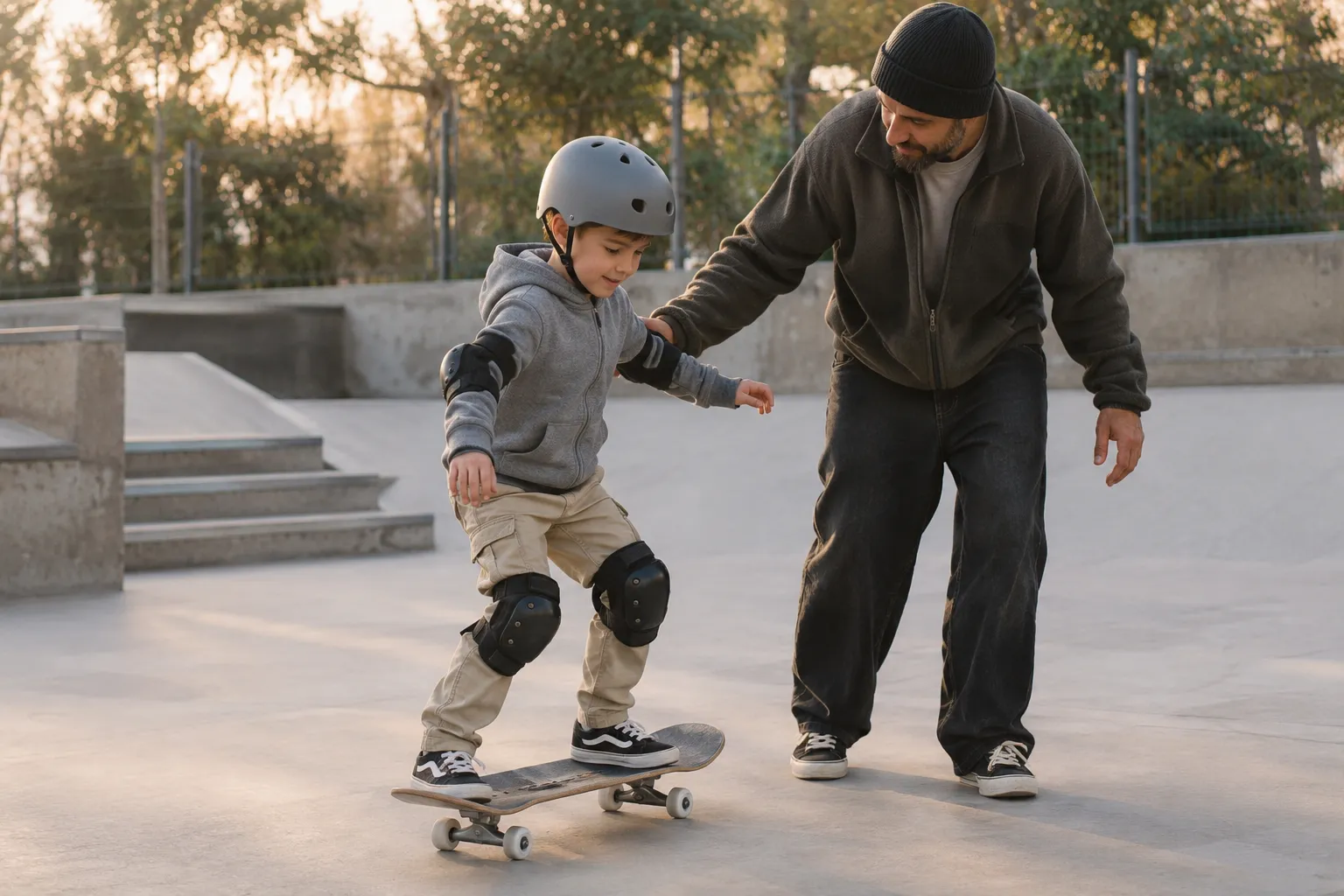
If your kid has asked for a skateboard and you’ve never set foot in a skatepark, the product pages can feel like a foreign language: inches, “7-ply maple”, trucks, completes. To make it worse, every listing gives a different age for the same board. This guide is written for you, not for skaters.
Where the size charts disagree, which happens more than you’d expect, we tell you so.
What age can a kid start skateboarding?
There is a widely accepted answer, and it’s worth knowing before you look at prices. Children younger than 5 should not ride skateboards, and kids aged 6 to 10 should have close adult supervision (some guidance sets the close-supervision line at age 8). The two don’t contradict each other, they stack: no skateboarding before 5, and an adult nearby between 5 and 10.
The reasoning is physical, not generic caution: young children have a higher center of gravity, a nervous system that’s still developing and, above all, a poor sense of their own limits. Schools land in the same place. Skateistan, probably the NGO that has taught more kids to skate than anyone, works with ages 5 to 17, and 6 to 10 is the sweet spot for starting properly.
Here’s the uncomfortable part: the marketing doesn’t always follow. The Oxelo Play 120 is labeled for “ages 3-7”, two years below what pediatricians recommend. It’s not a bad product for what it is, but that age label comes from the brand, not from a doctor. We’d rather you know that before trusting the box.
What if my 4 year old insists?
It happens in a lot of homes, and the answer doesn’t have to be a flat no, more of a “not yet” to actual skating. At 3-4, what works is balance play: standing on a board that isn’t moving, on grass or carpet, sliding while sitting on flat ground, or rolling while holding an adult’s hand. A fair rule: ages 1-3, hand-held balance only; under 5 is probably too young; 6-10 is where it clicks. If the household insists anyway, keep it to smooth flat ground, hand in hand, helmet on, sessions measured in minutes. There’s no rush: whatever they’d learn at 4, they’ll learn faster at 6, with fewer scares.
Kids skateboard sizes: feet decide, age only orients
Skateboards are measured by their width in inches, and that’s where most of the decision lives. Size charts agree on the method even when they disagree on the numbers: pick by shoe size, use height as the second check, and treat age as orientation only. The most practical shop-floor tip: most of the foot should rest on the deck, with toes and heel hanging over slightly.
This table puts the most granular kids’ size chart together with the usual commercial categories:
| Deck width | Age (rough) | Shoe size (EU) | Category |
|---|---|---|---|
| 6.5”–6.75” | 3–5 | 23–28 | micro |
| 7.0” | 5–7 | 28–32 | mini |
| 7.125” | 6–8 | 29–33 | mini |
| 7.25” | 7–9 | 30–34 | mini |
| 7.375” | 8–10 | 31–35 | mini |
| 7.5” | 9–11 | 32–38 | mid |
| 7.625” | 10–12 | 33–39 | mid |
| 7.75”–7.875” | 12–14 | 35–42 | full size |
| 8”+ | 14+ | 42+ | full size |
On height, there are three quick-check bands: up to 4’4” (1.32 m), a board of 7 inches or less; 4’5” to 5’2”, between 7 and 7.5; from about 5’3” up, adult widths from 7.5. And for teenagers past 5 feet, 8.0 is the neutral size.
Now the important warning: the charts don’t agree on ages. Some lump everything at 7 inches or under into “8 and younger”, with no detail; others split that same zone into three brackets. And Santa Cruz labels its 7.25 board “Super Micro, ages 3-6” while other charts place the same width at ages 7-9. Three years apart for the same board. Nobody’s lying; age just predicts a child’s body badly. Two 7 year olds can be a size and a half apart in shoes and 15 cm apart in height. So feet and height decide, and the birthday only narrows the search. The micro, mini and mid labels aren’t standardized across brands either, so use them to orient yourself, not as exact sizes.
Two tips that come up in several guides and settle the classic parent question. One: between two sizes, the smaller one, especially on a first board. Two: don’t buy big “to grow into”. An oversized board weighs more, is harder to turn, and makes learning an uphill climb. If the kid is still skating in a year, needing a new board is the best possible news.
You don’t need to study trucks and wheels: on a branded kids’ complete they come matched to the deck width, which is exactly what a parent can’t verify by eye. For reference, soft wheels are best for kids (durometer 92A or less) at 52-54 mm, with 7-ply maple decks, the industry standard. If you want to go deeper on decks themselves, we have a full guide on how to choose a skateboard deck.
Branded complete vs toy-store board: how to tell them apart
The usual starting recommendation: for a kid who’s beginning, a branded complete, meaning a board assembled at the factory by an actual skate brand. It’s cheaper than buying parts separately, the components already match, and if the kid drops it after three months (it happens), you haven’t funded a workshop. Building from parts makes sense once the first board is worn out, not before: the deck alone costs £25-50, and you’d still need trucks, wheels, bearings, grip tape and assembly.
The problem is that bazaars, toy stores and marketplaces are full of toys dressed up as skateboards. These are the warning signs:
- Plastic trucks, or metal ones that don’t lean when you press the edges of the deck.
- Rock-hard wheels that rattle on any normal asphalt.
- Unspecified wood: if it doesn’t say “7-ply maple”, bad sign.
- Grip tape with no actual grit, or a smooth printed top. Feet slide.
- Character or license graphics with no skate brand behind them.
- No recognizable brand on a marketplace: a lottery, in the British guide’s own words.
- Bearings that barely spin. With an honest caveat: spinning a wheel by hand is not a reliable quality test, because a bearing with little grease spins longer unloaded. The real test is pushing the board and seeing how far it rolls on its own.
On price, the pattern is fairly consistent: a kids’ complete from a real brand costs roughly 50-110 € ($60-120 / £45-90), with entry brands (Enuff, Venom) at the low end and the big names (Santa Cruz, Almost, Birdhouse) at the top. Well below that, new, be suspicious. One more habit that costs nothing: check for loose or broken parts before riding, new boards included.
If the budget is tight, our guide to affordable skateboards and decks covers what’s worth buying at the low end and what isn’t.
How to use the kids skateboard explorer
Below are kids’ and youth completes that are currently sold, grouped by age bracket and filterable by approximate price and by tags (first board, skate brand, micro, mini, mid). Each card says which sizes exist, which kid it suits and what the catches are, including the age disagreements between brands. Prices are approximate and change by shop and season; the age brackets are the brands’ own, not ours.
Ages 3–5
Oxelo Play 120
Oxelo's basic kids' board, which the brand labels for ages 3-7 (4-7 in some markets) and presents as designed by a team of skaters for kids who are learning. It's the easiest big-box option to find across Europe.
Worth knowing: that age label clashes with the usual recommendation that children under 5 shouldn't ride skateboards at all. It makes sense as a heavily supervised first board for balance play on flat ground, closer to an upgraded toy than to a skateboard for learning tricks.
Oxelo's names and ranges change by country and year, so check the local catalog before buying.
Santa Cruz Classic Dot Super Micro 7.25"
The smallest rung of Santa Cruz's youth ladder, which the brand labels Super Micro 7.25", ages 3-6. It's one of the few big brands with its own age-based naming, and a factory complete with real skateboard components. Listed at roughly $80-120 / £79.95-89.99.
Mind the age, though: size charts place a 7.25" board at ages 7-9, four years above what Santa Cruz says for the same width. Measure the kid's feet and height before deciding by the model name.
It's also one of the priciest kids' completes on this list; you're paying for the brand and the classic dot graphic.
Ages 6–8
Almost First Push youth 7.0" and 7.25"
Almost's youth completes (Dwindle group) in genuinely kid-sized dimensions: 7.0" × 29", which suits ages 6-8, and 7.25" × 29.2". Seven-ply maple, Tensor trucks and 52 mm wheels.
The catch is pricing by region: in the US they run about $60-90, but in Europe they climb to 90-111 € with VAT. At that price they compete with Santa Cruz's youth boards.
Enuff junior 7.25"
Enuff is a UK brand dedicated almost entirely to beginner completes, with a junior line at 7.25". The Meltworld sells for around £49.95 and the Graffiti II Junior for £54.95, roughly 55-65 €.
It's not a board for showing off a logo, but the components are functional, the price is contained and it's widely distributed in Europe. A sensible first real board without jumping to big-brand prices.
Venom junior 7.25"
Another entry-level brand from the UK market, with junior completes at 7.25" between £39.95 and £59.95, around 45-70 €.
It's the cheapest option on this list that is still a real skateboard rather than a toy. The practical catch: we couldn't confirm availability outside the UK, so you may need to order from a British shop.
Birdhouse Stage 1 (minis 7.25" and 7.38")
Birdhouse's factory complete line, from Tony Hawk's brand. In kids' sizes we've seen the 7.25" Oversized Skull Mini and the 7.38" Chicken Mini, plus 7.5" and 7.75" for older kids. Graphics kids tend to like, and the entry level of a real brand.
The price swings a lot between shops: from £34.95 on sale in the UK to €99.95 on marketplaces. Compare before buying.
One heads-up: in recent listings the line shows up renamed as Level 1, so you may find it under either name.
Santa Cruz Micro 7.5" and Mini 7.75"
The two middle rungs of Santa Cruz's youth ladder: Micro 7.5" for ages 4-8 and Mini 7.75" for 6-10. Factory completes from a major brand, with the quality you'd expect.
Santa Cruz's ages run notably more aggressive than size charts, which put a 7.5" at ages 9-11 and a 7.75" at 12-14. For a 6-8 year old with small feet, these widths can be too much board; check shoe size before the model name.
Ages 9–12
Powell Golden Dragon 7.5" × 28.65"
The budget line of the Powell Peralta group. Its 7.5" × 28.65" format is one of the few mids with a shortened length for kids, and it also exists in 7.5" and 7.625" at standard length. It ships with 90A wheels, soft, which is what's recommended for kids.
In the US it runs $69.95-79.95. The real catch is stock: many listings show as sold out and European availability is patchy, so if you see it at a fair price, don't wait long.
Mini Logo Chevron Detonator 7.5"
Mini Logo is the Powell group's no-graphics brand, and its Chevron Detonator completes are the usual value reference: 7-ply birch, Mini Logo trucks and 90A wheels. It runs £40-60 on sale (previously £70-80).
With no flashy graphic, a kid may find it plain. In exchange, it's about as much skateboard as that money buys in the 9-12 bracket, and the Powell group has been manufacturing for decades.
Oxelo Mid 500
The serious step of Oxelo's kids' range, labeled for ages 8-12 and meant for getting started with ollies, flips and grinds. It's not suitable for kids under 1.30 m.
We couldn't confirm its current price, and the Oxelo range names (Mid 500, CP100 Mid 7.5") vary by country and year. If your kid already rides and wants tricks, compare it against a skate-brand complete in the same range before deciding.
Teenagers
Mini Logo Chevron Detonator 7.75"
The near-adult width of Mini Logo's complete: 7.75", the size usually associated with ages 12-14 and a natural transition board toward adult widths. Same recipe as the 7.5": 7-ply birch, Mini Logo trucks, 90A wheels and zero graphics.
For a teenager past roughly 1.50-1.60 m, remember that an 8.0" from any brand is the usual next step; this 7.75" fits better in the early teens.
Birdhouse Stage 1 7.75" (Hawk Spiral)
The large size of Birdhouse's complete line: 7.75", with the Hawk Spiral graphic. For a teenager starting out, it's the affordable way to ride a recognizable brand with decent factory components.
As with the mini sizes, the price varies widely between shops (from sales around £35 to about €100 on marketplaces) and recent listings show the line renamed as Level 1. Worth comparing two or three shops before ordering.
Nothing matches those filters.
Helmet and pads: the minimum to start
We’re not trying to scare you, because skateboarding done sensibly is a great sport for a kid, but the helmet is not negotiable. And it needs to be a skate helmet, not the bike one they already own: hard shell with a foam liner, built to take more than one knock. The certification to look for is dual CPSC + ASTM F1492 (stickers inside the helmet); in Europe, EN 1078 is the legal minimum for sale. Fit matters as much as the label: snug, level on the head (the classic kid mistake is wearing it tipped back) and with the chin strap always buckled, because a loose helmet flies off on impact. After a hard hit, new helmet.
On pads, wrist guards are especially important, because kids break falls with their hands, and knee and elbow pads are a good idea for the first year. You may run into some percentages about how much pads reduce injuries; those numbers come from a 1990s in-line skating study, not from skateboarding, so we won’t repeat them here as skate facts. The standards, the kids’ models and the fine print on those figures are all in our skateboard helmets and pads guide.
First steps: what to expect in the early weeks
The ideal place to start isn’t the skatepark, it’s any smooth, quiet flat: a driveway, an empty parking lot on a Sunday, a path with no cars. Inspect the ground first (holes, rocks, gravel), ride in daylight and always away from traffic; most young skaters get hurt on streets, sidewalks and parking lots, not in skateparks. Two rules worth setting at home from day one: never two kids on one board, and never holding onto a bike, scooter or vehicle.
The progression schools teach is always the same: balance on a board that isn’t rolling (grass or carpet), then figuring out whether the kid is regular or goofy (which foot goes in front), then pushing and gliding, then turning and stopping. Tricks and ramps come much later, and skipping stages is the classic recipe for a scare. Count on weeks before they roll comfortably, and months before the first ollie.
On expectations, one statistic with its context: it’s often repeated that a third of skateboarding injuries happen in the first week of riding. That number traces back to a 1977 study, so take it for what it is, an old warning that the first days are the delicate ones, not a current statistic. The practical reading doesn’t change: the first two or three weeks are for balance and pushing, pads on, adult nearby. It also helps a lot if the kid learns early how to fall; we wrote a whole piece on how to fall off a skateboard without getting hurt.
What about a penny board, a cruiser or a surfskate?
It depends on what the kid wants it for, and it’s worth asking them before buying. A penny (those small plastic boards) works for cruising, balance and hanging off a backpack, but not for learning real skateboarding: plastic doesn’t have the pop of maple and the tiny trucks make tricks close to impossible. Plastic mini-cruisers are fun, but they’re not a good way to learn to skate. If the kid wants to do tricks like in the videos, no penny; if they just want to roll to school, it can work.
A kid-sized wooden cruiser is a better bridge than a penny if rolling around is all they want: more deck to stand on and soft wheels. A surfskate is a niche product aimed at surf training; kids’ sizes exist (SmoothStar, YOW and Carver all list them), but they cost noticeably more, around 150-250 €, and the pivoting front truck doesn’t teach the basics of a normal skateboard. Our take: only if the family surfs.
Keep exploring
- Affordable skateboards: what to buy on a budget
- Skateboard helmets and pads: the full guide
- How to fall on a skateboard without getting hurt
- Gifts for skateboarders
- How to choose a skateboard deck
- Skatepark directory
Frequently asked questions
What age can a kid start skateboarding?
Children under 5 shouldn't ride skateboards, and kids aged 6 to 10 need close adult supervision (some guidance says under 8). Skate schools line up with that: Skateistan, the best-known teaching NGO, works with kids from age 5.
What size skateboard does a 5 year old need?
Usually a micro or small mini: around 6.75 to 7.0 inches wide, depending on shoe size. Charts tend to put 6.5-6.75 inch boards at ages 3-5 and 7.0 at 5-7. Shoe size and height matter more than the birthday, so check those first.
What size skateboard does a 7 year old need?
A junior complete around 7.0 to 7.25 inches wide, depending on their feet. Size charts place 7.0 at ages 5-7 and 7.25 at 7-9, and a 7.25 by 29 inch junior complete suits a 7-8 year old. If in doubt between two sizes, take the smaller one.
What size skateboard does a 10 year old need?
It's the transition zone: 7.375 to 7.625 inches depending on shoe size. Other charts put the 9-12 bracket at 7.1-7.5 inches, and a 7.75 is fine if the kid is already close to 5 feet tall. Height and feet decide more than age does.
Are cheap toy-store skateboards okay for learning?
Not really. They tend to have plastic trucks that don't turn, rock-hard wheels that rattle on normal asphalt, and unspecified wood. A kids' complete from a real skate brand costs roughly 50-110 euros (about $60-120); well below that, new, be suspicious.
Should I buy a bigger skateboard so my kid can grow into it?
No. Between two sizes, go smaller, especially for a first board. An oversized board is heavier and much harder for a kid to turn, so they learn worse and give up sooner.
Is a penny board good for a kid starting out?
It works for cruising, balance and carrying around, but not for learning real skateboarding. Plastic doesn't have the pop of maple and the small trucks make tricks close to impossible. If your kid wants to do ollies like in the videos, get a kid-sized skateboard instead.
What helmet does a kid need for skateboarding?
A skate-specific helmet: hard shell, foam liner and a chin strap that's always buckled. Dual certification (CPSC plus ASTM F1492) is the one to look for; in Europe, EN 1078 is the legal minimum. It should sit snug and level on the head, not tipped back, and after a hard hit it gets replaced.
Conversation
Your name will be public. Your email stays private. Comments are reviewed before publishing.