Around 70,000 skateboarding injuries a year end up in US emergency rooms, and roughly half of them involve kids under 15. Most aren’t serious: wrists, ankles, the odd cut on the face. Still, that number is why so many parents, and plenty of adults picking up a board for the first time, ask the same thing before heading to the park: which helmet should I buy, and which pads are actually worth it?
Where opinions differ, we say so, and when a number comes from a different sport, we say that too.
What the injury data says
The most complete study on kids and teens is by McKenzie and colleagues (Injury Epidemiology, 2016). They looked at US emergency department visits from 1990 to 2008 for ages 5 to 19: an average of 64,572 visits a year, almost nine in ten of them boys, with 11- to 14-year-olds making up 44.9% of cases.
The breakdown by body part goes a long way toward explaining which gear makes sense: 44.1% of injuries were to the arms and hands, 31.7% to the legs, 11.4% to the face and 7.8% to the head and neck. Fractures and dislocations were 32.1%, traumatic brain injuries 4.6%, and only 3.1% of patients were admitted. One detail for parents: kids aged 5 to 10 had a higher share of head and neck injuries than 15- to 19-year-olds (9.9% vs 7.2%). Another is surprising: 37.3% of injuries happened at or around home, more than on the street (29.3%) or at sports facilities like skateparks (24.5%).
Total numbers vary depending on who’s counting: about 70,000 ER visits a year across all ages in one count, while an older analysis counted more than 100,000 in 2001 for riders aged 7 and up. They cover different populations, so they shouldn’t be merged into one figure. Wrist fractures, ankle sprains and facial cuts are the most common injuries, and the most serious crashes tend to involve cars. The often-repeated claim that a third of injuries happen in the first week of learning comes from a 1977 analysis, so it’s an old number.
What we know about helmets
The only skateboard-specific study with helmet data is a 2022 one: almost 25,000 skateboarders treated at US trauma centers between 2007 and 2016. Only about 5.5% wore a helmet, and wearing one was linked to roughly half the odds (odds ratio 0.534) of a severe traumatic brain injury. It’s a retrospective study of trauma patients only, so it can’t give you a percentage reduction. One important point: no helmet design has been proven to prevent concussions. Helmets are built to prevent skull fractures and severe brain injuries.
Helmet standards in plain English
The sticker inside the helmet is the only thing that really tells you what you bought. These are the three standards you’ll run into.
CPSC 16 CFR 1203 is the mandatory US standard for bike helmets made since 1999. Helmets are dropped from about 2 meters (6.6 ft) onto a flat anvil, peak acceleration can’t go above 300 g, and each hit lands on a different spot: the helmet is designed to absorb one hard impact in each area.
ASTM F1492 is the skateboard-specific standard. It’s voluntary, and the current edition is F1492-25, issued in September 2025. The difference is that it hits the same spot more than once (in the 2022 edition, at least one location takes three consecutive impacts), from a drop roughly half the height of the CPSC bike test. The test area also reaches further down the back of the head, because skaters fall backward more often, as Health Canada points out.
EN 1078 is the European standard, and its official name gives it away: helmets for pedal cyclists and for users of skateboards and roller skates. One standard covers both, so in the EU a bike helmet with EN 1078 is legally a skate helmet.
What “dual certified” actually means
In theory, a dual-certified helmet meets both CPSC 1203 and ASTM F1492: it handles one hard hit and several moderate ones. But be careful: some brands use the term for helmets certified to CPSC and EN 1078, without ASTM, and that sometimes only some sizes of a model are certified. The safe move is to check the sticker on your size for the literal text “ASTM F1492” and “CPSC”.
EPS, EPP and soft foam
- EPS (expanded polystyrene): the stiff foam in bike helmets and most certified skate helmets. It absorbs a hit by crushing, and it doesn’t bounce back.
- EPP (expanded polypropylene): looks similar, feels slightly rubbery. It recovers and can take a few more hits, although nobody can tell you how many.
- Soft foam: what you find in classic non-certified skate helmets, such as the Pro-Tec Classic Skate. Light and comfortable, but they haven’t passed any standard.
There’s a contradiction here. The ASTM skate standard requires a multi-impact helmet, yet the best-selling certified skate helmets (the Pro-Tec Classic Certified and the Triple Eight Certified Sweatsaver) use EPS, a foam that crushes once. The most honest reading is to rate skate helmets as “single/multiple” impact: they can take several moderate knocks, but after a hard slam the EPS may be crushed even if you can’t see it, and replacing it is the sensible call.
Is MIPS worth it?
MIPS is a low-friction inner layer meant to reduce rotational energy in a crash. Lab results, all on bike helmets, are mixed: a 2024 comparison measured up to 44% lower rotational acceleration in one test condition, while a 2020 study found no significant difference once a realistic scalp layer was added. None of the three standards tests rotation, so certification and fit matter more.
When to replace your helmet
Replace an EPS helmet after a hard impact, even with no visible marks, and a multi-impact helmet when it’s visibly damaged or after several solid hits. Cracks and worn straps are also reasons to replace it, and so is a kid outgrowing it. On age, the advice doesn’t line up: some say at least every 5 years, others say follow the manufacturer and, without guidance, consider replacing it within 5 to 10 years. It’s also best to avoid adding stickers or attachments that didn’t come with the helmet, which clashes with a lot of skaters’ habits.
Can you use a bike helmet for skateboarding?
Opinions differ. In the US, skateboarding is assigned to an ASTM F1492 skate helmet, and some argue skateboarding needs its own type of helmet. On the other side, a bicycle or multi-sport helmet that meets CPSC standards is often recommended, California law asks for a bicycle helmet, EN 1078 covers both uses in Europe, and World Skate accepts certified bike helmets.
Put together: a certified bike helmet is far better than nothing and it’s legal in California and the EU, but it’s built for a single hit and usually covers less of the back of the head. For skating, the ideal is a helmet with both CPSC and ASTM F1492.
How a skateboard helmet should fit
Measure your head with a soft tape where a cap would sit: mid-forehead just above the eyebrows, above the ears, and around the back. Measure a few times and go with the largest number; if you’re between sizes, most guides say size up. Always use the manufacturer’s chart, because the same measurement maps to different sizes from brand to brand.
Then use the “2-V-1” rule:
- 2: two fingers between your eyebrows and the rim. The helmet sits level, not tipped back.
- V: the side straps form a V just below the ears.
- 1: one finger between the chin strap and your chin.
That last one has some disagreement: some say one finger, others say two. Our take is one, two at most, and the helmet shouldn’t shift forward or sideways. A loose helmet can come off on impact.
With kids, two tips: don’t buy a helmet for them to grow into, and bring them to the shop to try it on. For reference, the S1 Mini Lifer fits heads of about 47-52 cm, and S1 recommends it up to age 6 if you can’t measure. One more warning: take the helmet off before the playground or climbing trees, because it can get caught.
Skateboard pads, one by one
Are wrist guards worth it?
They’re the pads with the best evidence, with one caveat: there’s no trial on skateboarders. In a study of in-line skaters (Schieber, NEJM, 1996), not wearing wrist guards meant 10.4 times the odds of a wrist injury. A systematic review on snowboarding (Russell, 2007) found guards lowered the risk of wrist fracture (relative risk 0.29), with roughly one injury prevented for every 50 riders wearing them. In a 1997 cadaver study, it took more energy to break the forearm with a guard on.
Be careful with one widely shared statistic. A figure that circulates says elbow pads can reduce injuries by 80%, knee pads by 30% and wrist guards by almost 90%. Those numbers match the 1996 in-line skating data, and the knee pad result in that study wasn’t even statistically significant. They’re not skateboarding numbers.
What about the idea that wrist guards “move the fracture up the arm”? A 1995 paper based on case reports raised it, and the 2007 snowboarding review saw hints of it in non-experimental data. The stronger biomechanical studies don’t back it up: a 2010 study with 28 volunteers found guards reduced peak accelerations at the elbow, and a meta-analysis estimated 54% fewer wrist injuries with no matching rise in shoulder injuries. On what we know today, the balance favors wearing them.
Some buyers say certain kids’ wrist guards are so stiff they almost immobilize the hand, so check that your kid can still plant a hand and grab the board. Pads also work better when you know how to fall, which we cover in how to fall on a skateboard.
Elbow pads
In the same in-line skating study, not wearing elbow pads meant 9.5 times the odds of an elbow injury. Different sport, but the mechanics are similar: falling backward or sideways onto an arm.
Knee pads
Knee and elbow pads mainly reduce cuts, scrapes and gravel burns, and riders doing tricks should go for heavy-duty gear. In the 1996 study, knee pads showed no statistically significant effect.
There are two main types. Big hard-cap pads, like the 187 Pro Knee, are what most people wear on ramps, in bowls and on vert; skaters will tell you a hard cap lets you slide out of a fall on a ramp, but we couldn’t find any safety body that has studied it. Low-profile pads, like the Pro-Tec Street, are more comfortable for street, park and learning tricks.
Hips and tailbone
Padded shorts like the Triple Eight Bumsaver have roughly 10 mm of EVA foam over the hips and tailbone. They can help if you’re learning transition, but we found no injury data on them and reviews are mixed.
Is there a standard for pads?
In the US, no: only helmets have a standard. Europe has EN 14120 for wrist, elbow and knee protectors used in roller sports, and the standard itself admits they won’t necessarily prevent every injury.
Skateboard pads and helmets for kids
Children under 5 shouldn’t ride skateboards and kids aged 6 to 10 need close adult supervision; under 8s should be watched closely. The reasons are physical: young children have a higher center of gravity, less balance and slower reactions. Some Spanish skateparks, such as the one in Betero near Valencia, don’t let under-6s in at all.
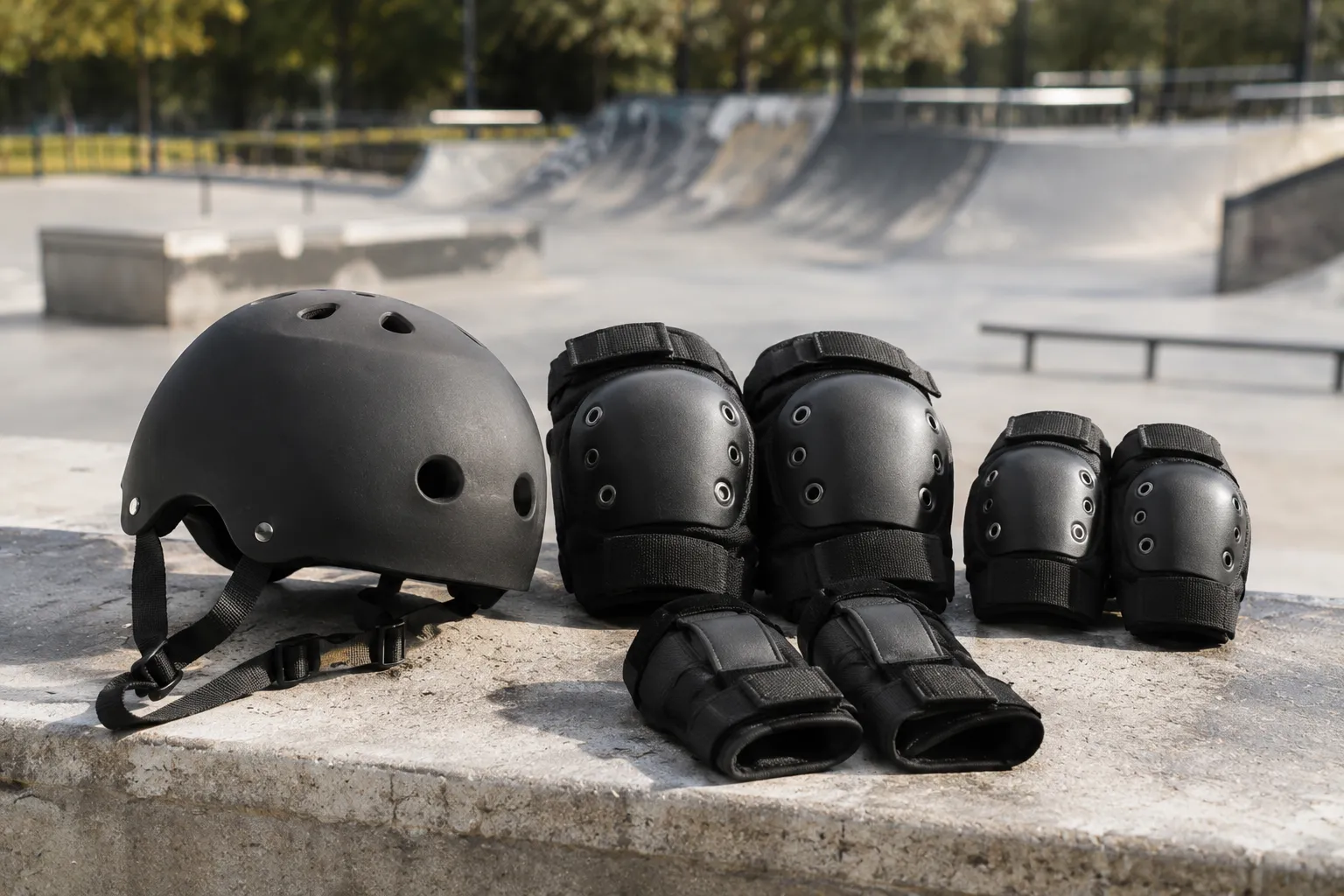
For a kid who’s starting out, the list is the same as for an adult: helmet, wrist guards, elbow pads and knee pads. A kids’ three-piece pad set covers the pads; the helmet is better bought separately, after trying it on.
Helmet rules at skateparks and contests
In California, the Health and Safety Code (section 115800) says skatepark operators can’t let anyone ride without a helmet, elbow pads and knee pads, with no age limit. The “under 18” rule people often quote is a different law: the Vehicle Code (section 21212) requires minors to wear a certified bicycle helmet when skating on streets and bike paths, with a fine of up to $25 that parents are jointly liable for. Outside California, each park sets its own rules: Tampa’s city skate parks require helmets for everyone, and at the Orlando Skate Park only adults can opt out.
In Spain, we found no national law requiring a helmet on a non-motorized skateboard. The helmet rules in the news (Royal Decree 970/2020 and the reform announced for 2026) apply to e-scooters and other personal mobility vehicles, not skateboards. What does exist is park-by-park rules: the Betero skatepark requires a helmet at all times and recommends knee, elbow and wrist protection, and several municipal regulations in the Balearic Islands, Formentera’s among them, require an approved helmet. We also found no skateboard helmet law in Germany, France, Italy, Portugal or the UK. In practice, read the sign at the entrance, or check the park’s page in our skatepark directory.
In competition, World Skate’s April 2025 rules make helmets mandatory for all park athletes at any age, and only for street athletes under 18; skipping it can mean disqualification. Pads are optional. Oddly, World Skate’s list of suggested helmet standards includes CPSC 1203 and EN 1078, but not ASTM F1492. The minimum competition age also goes up each year, from 11 in 2025 to 14 from 2028 onward.
How to use the gear explorer
Below are the helmets and pads that keep coming up, grouped by type and filterable by certification and by tags (kids, adults, beginner, park, street). Each card says which certifications we could confirm. It isn’t a ranking, because there’s no independent testing of skate helmets to rank them by. Prices are approximate.
Helmets
Triple Eight THE Certified Sweatsaver
One of the certified helmets you see most often at skateparks. ABS shell, EPS liner and a Sweatsaver lining that wicks sweat and comes out for washing. That lining is for comfort, not impact protection. No MIPS, and the vents are fixed.
Triple Eight sells it as dual certified: CPSC 1203 (ages 5 and up) and ASTM F1492. Check the sticker on the size you buy.
A good everyday helmet for park and street. Because it uses EPS, replace it after a hard hit. Size charts for this model don't always match, so measure your head and go by the brand's chart.
Triple Eight Gotham MIPS
The MIPS version of the Gotham, with an EPS liner. It is listed with CPSC and ASTM F1492 dual certification.
The MIPS version costs about $40-50 more than the regular Gotham. Since it carries the bike certification, it also works for riding your bike to the park or to school.
On MIPS itself, lab results are mixed and no standard tests rotational protection. It's a reasonable pick if it fits you well, but fit and certification matter more.
Triple Eight Brainsaver and Lil 8
The Brainsaver Dual Certified is the adult helmet and the Lil 8 is its counterpart for small kids. Both carry CPSC and ASTM F1492 certification, and both use EPS.
We didn't review the full spec sheet for either one, so we're not listing shell materials or sizes.
As with any EPS helmet, replace it after a hard hit, and for kids, also when they outgrow it.
Pro-Tec Classic Certified
Pro-Tec's classic skate shape with a high-impact ABS shell, EPS liner and 11 vents. It is listed with ASTM F1492, CPSC 1203, AS/NZS 2063 and EN 1078.
Worth knowing: descriptions of it aren't consistent, with some calling it multi-impact and others saying it protects against a single high impact. Check the sticker on your size.
It's durable and suited to aggressive riding, at roughly $60-70 in the US.
Pro-Tec Classic Skate
From the outside it looks a lot like the Classic Certified, but inside it uses soft two-stage foam and carries no certification. It's light and comfortable.
It's pitched for mellow cruising where hard hits are unlikely. If you want a helmet that has passed a standard, the one you're after is the Certified version.
When buying online, double-check the exact model name, because the product photos of the two are almost identical.
S1 Lifer
ABS shell with multi-density EPS Fusion Foam. It carries ASTM F1492 and CPSC 1203, and some versions EN 1078 as well (it depends on the exact model). It weighs about 400 g.
S1 markets it as a multi-impact helmet for park, bowl and vert. The claim that it's five times more protective than a soft-foam helmet comes from S1 itself, with no independent data behind it.
Be careful with the term "dual certified", which is sometimes used for CPSC plus EN 1078. The Lifer size fits heads of about 52-59 cm, and the Mega Lifer 58-65 cm.
S1 Mini Lifer
The kids' version of the Lifer, for heads of about 47-52 cm. S1 recommends it up to age 6 if you can't measure your child's head, although the two size charts don't quite match.
It carries ASTM F1492, CPSC and EN 1078. It comes with pads in different thicknesses (the Fit All Kit) to fine-tune the fit.
Ideally, try it on in a shop with your kid, and don't size up for them to grow into.
Bell Local
The Bell Local is certified to CPSC and ASTM F1492.
We couldn't confirm materials or the fit system, so we're not listing them.
As with any model, check the sticker inside to make sure the size you buy carries both standards.
Knee pads
187 Killer Pads Pro Knee
A big hard-cap knee pad, very common on vert, in bowls and on large transition. It has replaceable Lock-In caps (the ReCaps fit both the Pro Knee and the Pro Derby), V22 dual-density foam, three-panel ballistic nylon and an open back with Velcro.
The US price is around $130-140. The idea that a hard cap lets you slide out of a fall on a ramp comes from skaters, not from a study.
It's a pad for people who ride transition regularly. For learning on the street or at a small park, a lower-profile pad is usually enough.
Pro-Tec Street Knee
A low-profile knee pad with a ballistic nylon shell, hard cap and EVA foam. There's an open-back version, which goes on without taking your shoes off, and a sleeve version, which stays put better but has to go over your foot.
It suits street, park and learning new tricks. The knee and elbow set runs about £30-40 in the UK.
For big ramps, a lot of people prefer a larger cap like the one on the 187 Pro Knee.
Elbow pads and wrist guards
Pro-Tec Street Elbow
The elbow pad from the same Street range: ballistic nylon, hard cap, EVA foam and a low profile, aimed at street, park and learning.
For elbow pads in general, the most cited figure comes from in-line skating: in a 1996 study, not wearing them meant 9.5 times the odds of an elbow injury. There's no equivalent study on skateboarders.
Sold on its own or in a set with the Street knee pad.
187 Killer Pads Pro Wrist Guard
187's wrist guard, in sizes XS to XL, at an official US price of about $45-50.
The evidence for wrist guards comes from in-line skating and snowboarding: they reduce wrist fractures, and the better biomechanical studies don't support the idea that they push the injury up to the elbow. There are no trials on skateboarders.
When you try them on, make sure you can still plant your hand and grab the board comfortably.
Pad sets and padded shorts
Triple Eight Saver Series (3-pack)
A set with knee pads (KneeSaver), elbow pads (ElbowSaver) and wrist guards (WristSaver), from around $40. The junior version uses EVA foam and polycarbonate caps.
Wrist guard sizes go by hand circumference around the knuckles: JR 6-7 in, S 7-8 in, M 8-9 in and L 9-10 in.
It's the cheapest way to get all three pads when you're starting out. The kids' wrist guards can be very stiff, so check that your child can still move their hand well.
187 Killer Pads Pre-K Six Pack
A 187 pad set sized for pre-kindergarten kids, based on the brand's Six Pack. The US price is around $65-70.
We couldn't confirm exactly which pieces are included, so check the product page before buying.
Keep in mind that children under 5 shouldn't ride skateboards and kids aged 6 to 10 need close adult supervision.
Triple Eight Bumsaver
Compression shorts with roughly 10 mm of EVA foam over the hips and tailbone. The Bumsaver 2 claims gap-free coverage of the hips, sit bones and tailbone.
They can help if you're learning transition or keep landing on your butt, for kids and adult beginners alike.
We found no injury-reduction data, and opinions are mixed: some people say the pads migrate or don't cover the hip bone.
Nothing matches those filters.
Keep exploring
- How to fall on a skateboard without getting hurt
- Skatepark etiquette: the unwritten rules
- How to ollie on a skateboard
- Skateboarding health benefits, backed by studies
- Skatepark directory
Frequently asked questions
Do you need a helmet to skateboard?
Legally, adults riding on the street usually don't. We found no law requiring one in Spain, Germany, France, Italy, Portugal or the UK. In California, under-18s must wear a certified bicycle helmet on streets and bike paths, and at California skateparks everyone has to wear a helmet, elbow pads and knee pads. Doctors recommend one anyway: a properly fitting helmet is essential at any age and skill level.
Are wrist guards worth it?
The evidence is good, although it comes from other sports. In in-line skaters, not wearing them meant about 10 times the odds of a wrist injury (NEJM, 1996), and in snowboarders they cut the risk of wrist fracture (2007 review). There's no trial on skateboarders, and the idea that guards move the break up to the elbow isn't supported by the better biomechanical studies.
Can I use a bike helmet for skateboarding?
Opinions differ. In Europe, EN 1078 covers both bikes and skateboards, and California and World Skate accept certified bike helmets. In the US, on the other hand, skateboarding falls under ASTM F1492 skate helmets. A certified bike helmet is far better than nothing, but it's built for one hit and usually covers less of the back of the head. The ideal is a helmet certified to both the CPSC bike standard and ASTM F1492.
How often should you replace a skateboard helmet?
If it has an EPS liner, after any hard impact, even if it looks fine. If it's a multi-impact helmet, when it's visibly damaged or after several solid hits. By age, some advice is at least every 5 years, while other advice is to follow the manufacturer and, without guidance, consider replacing it within 5 to 10 years. Kids also need a new one when they outgrow it.
What age can a kid start skateboarding?
Children under 5 shouldn't ride skateboards and kids aged 6 to 10 need close adult supervision (under 8s should be watched closely). Young kids have poorer balance and slower reactions, and proportionally they hit their heads more often.
What does dual certified mean on a skate helmet?
Properly, that the helmet meets both the CPSC 1203 bike standard (one hard hit) and the ASTM F1492 skate standard (repeated moderate hits on the same spot). Some brands use the phrase for CPSC plus EN 1078 instead, so look for the exact text ASTM F1492 on the sticker inside the size you buy.
Do you have to wear a helmet at a skatepark?
It depends on the park. In California, a helmet, elbow pads and knee pads are required for all ages. Many US city parks require helmets for minors or for everyone, and plenty of municipal skateparks in Spain require an approved helmet. Check the rules posted at the entrance.
What pads does a beginner skateboarder need?
The standard list is: helmet, wrist guards, elbow pads and knee pads. Knee pads mostly prevent scrapes and bruises; for ramps and bowls, skaters tend to use big hard-cap models. Padded shorts are optional.
Conversation
Your name will be public. Your email stays private. Comments are reviewed before publishing.