
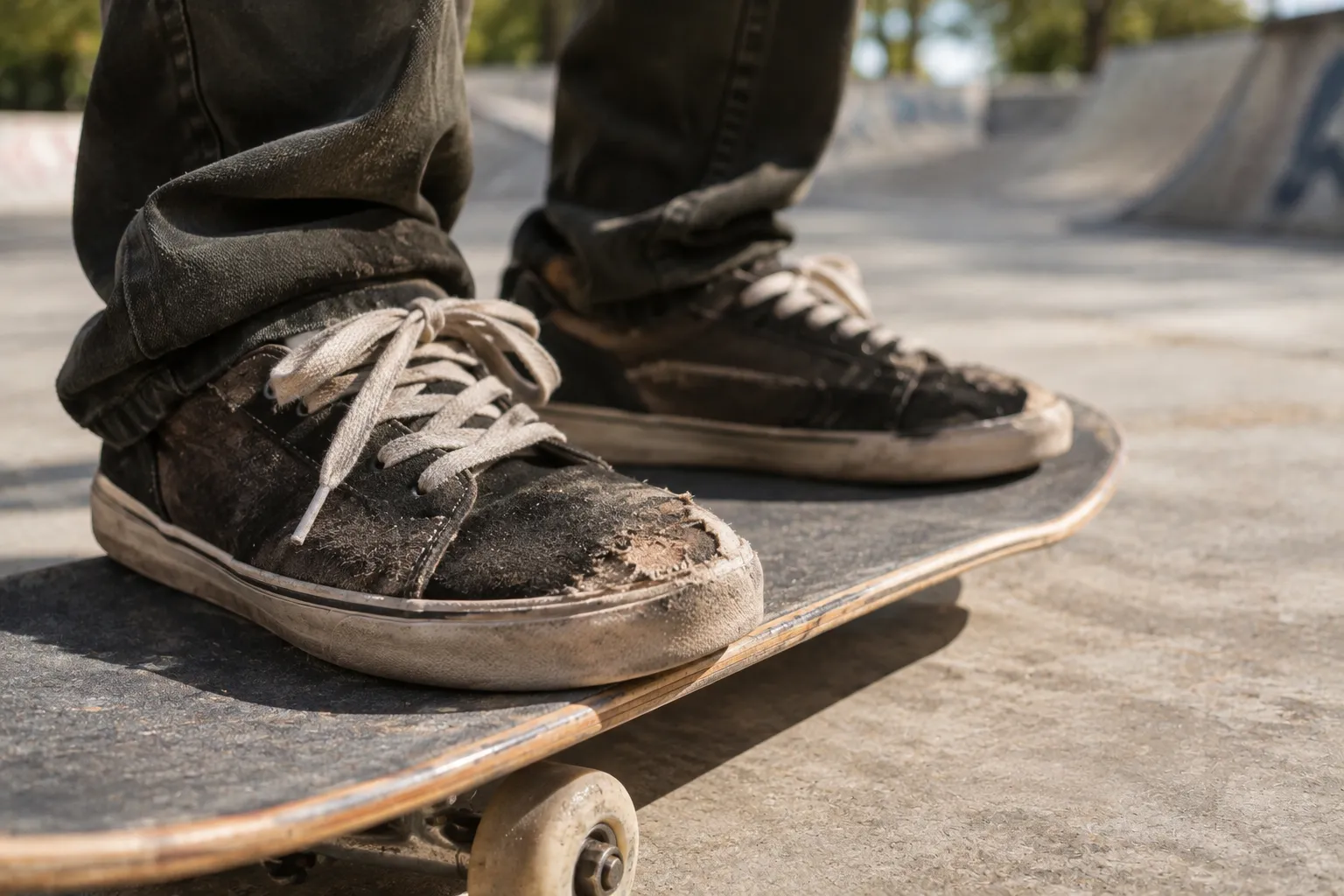
Walk into a skate shop for shoes and one of the first things you’ll be asked is whether you want vulc or cupsole. It’s the choice that changes how a shoe feels on the board more than any other, and it’s also the one that confuses people most, because a lot of current models mix both builds and product pages don’t always say so clearly.
We didn’t test the shoes ourselves. What follows is what ten-hour wear tests, lab measurements and buying guides found, including the places where they agree and the places where they don’t.
Vulc vs cupsole: the difference you’ll actually feel
How a vulcanized skate shoe is made
On a vulcanized shoe (vulc, as everyone calls it) the rubber outsole is bonded to the upper with heat: the rubber is heated and stretched onto the lasted upper before it’s fully cured. The foxing tape, the rubber band that wraps around the shoe, is part of the same build.
The result is a thin, flexible sole. You feel the board under your foot and there’s hardly any break-in: a vulc needs essentially none, and a pair of Vans Old Skools earned the top board-feel score (9.5 out of 10) in testing. The trade-off is impact protection: a thin vulc sole with a foam insole can’t compete with a good cupsole when you land from height. Vulcs also tend to lose their shape sooner.
How a cupsole skate shoe is made
On a cupsole the sole is a pre-formed unit, a rubber cup the upper sits inside, usually stitched around the sidewall. It protects your feet better on stairs and gaps and holds its shape better over the months. In exchange, a new cupsole is stiffer, sits a little higher and takes a few sessions to break in. In an interview, Vans senior designer Neal Shoemaker said the choice comes down to personal preference.
Hybrids are now the norm
This is the part a lot of lists skip: the line between vulc and cupsole has blurred. Vans has Wafflecup, a cupsole with a vulcanized rubber layer from midfoot to toe, a way to get cupsole support with vulc board feel. The Nike SB Ishod 2 embeds a vulcanized rim in a cupsole, and the New Balance Numeric Foy 306 Cup is a cupsole with a vulc-inspired forefoot. Nike sells the SB Force 58 on the promise of cupsole durability with vulcanized flexibility.
Then there are the thin modern cupsoles, like the adidas Glenburn, the Converse Louie Lopez Pro 2 and the Last Resort CM001, which rate very well on board feel for a cupsole.
| Vulc | Cupsole | |
|---|---|---|
| Board feel | More, from day one | Less, especially when new |
| Break-in | Almost none | A few sessions |
| Impact protection | Lower | Higher (stairs, gaps) |
| Shape over time | Loses it sooner | Holds it better |
| Grip | Often better out of the box | Sometimes improves with wear |
Suede, canvas or leather: the material sets much of the lifespan
Here’s the short version. Canvas is the lightest and most breathable, but it rips sooner. Suede resists abrasion, gives consistent grip and breaks in fastest. Leather is very durable and holds its shape, but takes the longest to break in and breathes less.
The wear tests back this up again and again. In ten-hour tests, the canvas Last Resort VM003 got a hole in the front within its ten-hour test, the canvas side panels on the Vans Curren Caples wore through at around the same ten hours, and on the Skate Old Skool the canvas midfoot panel took the most damage. Leather isn’t bulletproof either: on the adidas Tyshawn 2 the white top layer clearly abraded, although no new wear points appeared after that.
What stands out in the tests is that seams usually fail before the material does. On the New Balance Numeric Reynolds 933, most of the triple stitching in the ollie area tore; on the Converse AS-1 Pro, the toe panel started ripping after three sessions; and on the Last Resort CM001 the eyelet seams came apart after four to five hours. That’s why one-piece toes like the one on the NB# Foy 306 Cup work so well, and why a thin layer of super glue over the stitching helps.
Ollie-area reinforcement
Almost every brand now has its own way of protecting the spot that rubs against grip tape the most. Vans uses DURACAP, a rubber layer under the suede that aims to prevent holes and adds some structure (adidas has its own version, Adituff). Others put the rubber on the outside: the Etnies Marana’s toe cap did its job extremely well in testing, and the Emerica Pillar Mid combines a double-wrapped sole with an ollie guard. On the double-layer suede toes of the Nike SB Air Force 1 and the NB# 770, two holes appeared in the first layer after ten hours, and it was the second layer that saved the shoe.
Laces are easy to overlook, and they snap quickly in a flip-heavy session. Of the shoes tested, the Lakai Carroll was the only one with lace protection, and Last Resort places the eyelets on its VM001 and VM003 higher and closer together for exactly that reason.
Insoles and cushioning
Every brand has a name for its foam. At Vans, PopCush is the thick top-tier footbed and UltraCush the older one. Nike SB uses Zoom Air in the heel of the Dunk and the Janoski, React in the original Ishod and an Air Max element in the Ishod 2. adidas puts a Lightstrike wedge (the foam from its running shoes) in the Tyshawn 2, New Balance Numeric uses FuelCell and ABZORB in the 480, and Converse uses its CX foam.
It’s worth keeping expectations in check. Vulc cushioning tests as only average even with a premium insole, and anyone who regularly jumps ten-stairs will feel it in the Last Resort VM001. A good insole makes a shoe more comfortable, but it doesn’t replace a midsole.
Low, mid or high top
Low tops are the lightest and the usual pick for technical flip tricks, though they leave your ankle exposed to board hits. Mids are the middle ground (the Half Cab is the example), and high tops give maximum support and stability, breathe less and are often chosen by transition skaters. The Half Cab itself exists because skaters were cutting down the Caballero high-top for street, until Vans made the mid official in 1992.
One honest caveat: there’s no data showing that high tops prevent ankle injuries. They give more support and protection from board hits, which isn’t quite the same thing.
Skate shoe myths worth rethinking
- Cupsoles always last longer. Only partly true. A cupsole upper usually holds its shape better, but a thin cupsole without rubber wrapped around the toe can blow out early: the Converse Louie Lopez Pro 2 did so within a few sessions in wear testing. And some vulcs do very well, like the Last Resort VM001.
- Any pair of Vans or Dunks will do for skating. Not really. Lab abrasion tests measured 1.7 mm of outsole wear on the regular Old Skool, against a 1.1 mm average. The Skate line adds reinforcements the lifestyle model doesn’t have.
- Pricier means more durable. In testing the DC Kalis Vulc, one of the cheapest shoes, showed no early wear, while the regular Old Skool holed within a few sessions. The specific construction matters more than the price.
- Skate shoes last a set number of months. It depends on the hours you put in and on your grip tape. Fresh, gritty grip such as Mob wears shoes faster than Jessup.
How to use the skate shoe explorer
Below are 30 models that are still in production and that come up most often. You can filter them by brand, by construction (vulc, cupsole or hybrid) and by tag (street, transition, beginner, wide feet, narrow fit, budget, durability, impact or board feel), or search by name.
Each card sums up how the shoe is built and what testing found; where there’s no independent test, we say so. Three cards include 100-trick test videos.
Vans
Vans Skate Old Skool
A low-top vulc in suede and canvas. The Skate version adds DURACAP reinforcement under the toe suede, a PopCush insole, SickStick rubber for extra grip and taller foxing tape than the regular shoe.
In ten-hour wear tests of the Skate Classics line, the canvas midfoot panel took the most wear, and DURACAP stretched the life of the ollie area. On the Old Skool 36+ (2025) the foxing wore through at the kickflip spot while the suede and outsole stayed close to untouched. The regular Old Skool, without the Skate tech, did worse: it got a hole within the first few sessions in one test and measured above-average outsole wear in lab abrasion.
True to size with no break-in. The design dates to the late 1970s. The video is a 100-kickflip test with Corey Glick.
Vans Skate Half Cab
A mid-top suede vulc with PopCush, DURACAP and two-piece foxing tape in the 2022 version. There is also a Skate Half Cab Wafflecup, so check which one you're buying.
Its durability tested as exceptional: after ten hours the forefoot was almost untouched, and the first wear showed up on the tongue and heel, which is mostly cosmetic. Once it's broken in, it goes flat and a bit floppy looking.
It's Steve Caballero's shoe. Skaters were cutting down the Caballero high-top for street, and Vans made the mid official in 1992.
Vans Skate Sk8-Hi
A high-top vulc. The Skate version carries the Skate Classics reinforcement package.
It's the classic high-top pick, and a common choice for transition skaters because of the ankle protection against board hits. We couldn't find an independent wear test of the Skate version, so its durability is unverified.
The design dates to 1978, when it was called Style 38.
Vans Skate Era
A low-top vulc and the simplest of the Vans classics. It shares the tech of the rest of the Skate line, and there is also a Skate Era Wafflecup.
In ten-hour testing the little checkerboard flags didn't survive, but overall wear was minor. It makes sense if you want board feel and a very low profile.
Tony Alva and Stacy Peralta designed it in 1976 as style number 95.
Vans Kyle Walker
A lot of lists call it a vulc, but that's not quite right. The 2016 Kyle Walker Pro used Wafflecup (a cupsole with a vulcanized rubber layer from midfoot to toe), an UltraCush HD insole and DURACAP. The current model is sold as the Skate Kyle Walker Wafflecup.
Its durability tested very good, with no blowout spots in ten hours, though the board feel was weaker than expected from Vans because the sole feels thick. Other reports are more mixed: one tester expected about two more weeks before it ripped or went floppy, and outsole durability is a listed drawback on the Pro 2.
Vans Rowan 2
Rowan Zorilla's shoe has changed construction between generations. The original Rowan Pro was a vulc with PopCush; the Rowan 2 uses a cupsole-style ImpactWaffle sole with VR3Cush and a DURACAP toe.
In a 2023 test the forefoot upper was almost untouched after ten hours, and the board feel rated good for a cupsole. The Rowan Z3 was released in 2026; we haven't seen independent tests of the third version yet.
Nike SB
Nike SB Dunk Low Pro
A stitched cupsole in suede and leather, with the padded SB tongue and a Zoom Air unit in the heel of the insole. That's what sets it apart from a regular lifestyle Dunk.
The Dunk Low Pro IW rated well overall: excellent Zoom cushioning, average grip and a little stiff at first. The weak point is the visible toe seams, where the first signs of wear and holes appeared after ten hours.
Nike SB launched in 2002.
Nike SB Zoom Janoski OG+
A suede vulc with a Zoom Air insole. The original Zoom Janoski came out in 2009, designed by James Arizumi with Stefan Janoski.
The warning you'll see most is about sizing: it runs very narrow and small, so go up. Some people go up a full size.
We don't have a recent wear test. The only hours log we found comes from a single skater and puts it at about 60 hours, so treat that as anecdotal.
Nike SB Ishod 2
A hybrid build: a vulcanized rim embedded in a cupsole, a drop-in insole with an Air Max element glued into it, a stability strap and medial ventilation. It's Ishod Wair's shoe.
In testing the first wear appeared on the suede at the kickflip area, but the layered suede held up and so did the lace protection. True to size. On the original Ishod, the heel collar got shredded by grip tape quickly.
Nike SB Vertebrae
A cupsole with a honeycomb-cored outsole and a mesh and suede upper. It came out in February 2024.
We found no independent wear test. One account describes it as firm, with some break-in and a narrow fit, but that's a single opinion, so try it on first if you have wide feet.
Nike SB Force 58
A stitched cupsole that flexes like a vulc: Nike markets it as cupsole durability with vulcanized flexibility. Canvas and suede upper.
It has the best lab numbers on this list. It's the most durable shoe in lab testing: in a Dremel abrasion test the outsole lost 0.8 mm against a 1.1 mm average, and the toebox scored 4 out of 5 for durability. It weighs about 332 g.
It runs small, so go up half a size.
adidas Skateboarding
adidas Busenitz Pro
A suede cupsole with a soccer-boot look, descended from the Copa Mundial line. Dennis Busenitz signed with adidas in 2006 and his shoe arrived in 2009.
It's the best cupsole in lab testing, with a durability score of 89 out of 100, a true-to-size fit and a slightly narrow toe box. It isn't very breathable. In a long 2009 test (27 hours), the upper holed before the sole did.
adidas Samba ADV
A cupsole (one magazine has described it as a vulc, probably by mistake), with two layers of Adituff toe reinforcement.
It won a 2017 award for best board feel and grip, with no blowout spots in testing. It's one of the shoes that shows a slim cupsole can feel close to a vulc. We didn't find more recent independent tests.
adidas Campus ADV
A cupsole that replaced the Campus Vulc in October 2018. Two-layer suede and Adituff in the high-wear areas.
The only test we found is a shop's own, which gives it 10 out of 10 and says it needs no break-in; take the score with some caution.
adidas Tyshawn II
A leather cupsole with a Lightstrike foam wedge (the foam from adidas running shoes) and a dual-layer toe cap. It's Tyshawn Jones's second shoe, presented by adidas in 2024.
In testing the white leather clearly abraded, but once that top layer wore away no new abrasion points appeared, and the sole showed minimal wear. Sizing advice is split: some say true to size, while one tester went down half a size.
New Balance Numeric
New Balance Numeric 480
A cupsole with a FuelCell midsole and an ABZORB sockliner. It's based on a 1983 basketball design reworked for skating.
In testing there was only minor stitching wear on the double-stitched suede toe, and no holes. True to size. It comes up a lot as the pick if you want comfort and protection without a bulky cupsole.
New Balance Numeric 440
A low-profile cupsole with a C-CAP heel wedge. It's sold as vulc feel with cupsole protection, but that's marketing copy.
We found no independent wear test, so we can't tell you how long it lasts. If you're curious, try it on in a shop next to the 480 and compare.
New Balance Numeric Tiago Lemos 1010
A cupsole with FuelCell foam and a suede, leather and mesh upper. Tiago Lemos's shoe came out in 2022.
It's heavy, at about 455 g. There's no independent wear test, so it's more of an option for skaters who put cushioning first and don't mind the weight.
New Balance Numeric Foy 306 Cup
A cupsole with a vulc-inspired forefoot, a one-piece suede toe and an Ndurance outsole. It's Jamie Foy's shoe.
The board feel is impressive for a cupsole and the one-piece toe cuts down on seams, which are where shoes usually fail. The downside is that the tread collects small stones. Don't confuse it with the original vulcanized 306, which is a different shoe.
DC
DC Kalis Vulc
A suede vulc (SUPER SUEDE, in DC's terms) with an Ortholite insole. It's the 2020 vulc reboot of the 1999 Kalis cupsole.
It was the best value in one test: good board feel (8.5) and no early wear, although it lost its shape fairly quickly. Its durability score was 6 out of 10.
DC Manual
A suede vulc with a rubber toe cap. It comes in a low and a high-top (Manual Hi).
A 100-trick test featured Ish Cepeda doing heelflips in the Manual Hi; the results are only in the video, which you can watch here. Beyond that we found no written independent test, so its durability is unverified.
DC Lynx
A cupsole with a suede and mesh upper and shoe-in-shoe construction. These days it's sold in versions such as the Lynx OG.
The Lynx S tested in 2014: after ten hours, the sidewalls and sole showed hardly any wear and the board feel was surprisingly good. The original release year isn't clear, so we've left it out.
Etnies
Etnies Marana
A cupsole with a rigid outsole and an STI foam midsole. It was originally Ryan Sheckler's pro model, and it now also comes with a Michelin outsole and as a vulc (the Marana Vulc).
In testing the rubber toe cap did its job very well and the mesh at the heel was the first thing to tear. The shape is wide, which makes it one of the few shoes recommended for wide feet.
Etnies and Michelin claim up to three times longer life for the Michelin version, but that figure comes from the brands' own test of 30 skaters over 30 days, not an independent one.
Etnies Josl1n
Chris Joslin's shoe has a Michelin outsole, STI Evolution foam, a removable footbed and a hidden toe cap that reaches into the ollie area. It's most likely a cupsole, but we couldn't confirm it, so check the details before you buy.
A 20-hour skate test found the Joslin Pro still held its shape, though it's heavy and firm.
Other brands
Last Resort AB VM001
A vulc with a thick one-piece suede upper and a dual-density PU insole. Last Resort AB is the brand Pontus Alv (Polar Skate Co.) founded with Sami Tolppi.
Its durability tested very good in 2021: only light marks on the suede and one ripped eyelet seam, with plenty of life left. The cushioning falls short if you jump ten-stairs often.
It runs slightly big, so go half a size down; it breaks in after two or three sessions. Its canvas sibling, the VM003, got a hole in the front during its ten-hour test.
Last Resort AB CM001
The brand's first cupsole: a leather upper with a suede panel in the ollie and kickflip area, and a Cloudy Cush insole.
In testing the eyelet seams ripped after four to five hours, which turned out to be cosmetic, and the board feel was very good for a cupsole. It runs small: one tester wears a US 9 in the VM models and a US 9.5 in the CM001.
Converse CONS AS-1 Pro
A suede cupsole with CX foam and a herringbone outsole. Alexis Sablone designed it, and it came out in 2023.
The board feel is great, but the double-stitched toe started ripping after three sessions and blowout spots appeared around the tenth. True to size.
Converse CONS Louie Lopez Pro 2
A slim cupsole with CX foam and a wedge. Board feel is the standout: there's no break-in and the grip stays consistently strong.
The weak point is a blowout within a few sessions at the junction between toe and midfoot. The fit is slightly narrow and snug. It's the clearest example that a cupsole doesn't always outlast a vulc.
The 100-kickflip video with Louie Lopez features the first-generation Louie Lopez Pro, not the Pro 2.
Emerica Pillar Mid
A mid-top suede vulc with a double-wrapped rubber sole and an ollie guard.
It was the best overall pick in one test, scoring 8 out of 10 for durability with no holes. The insole is flat, so if you have high arches you may want to swap it for an aftermarket one.
Lakai Carroll
A cupsole with no forefoot midsole foam, a T-shaped suede toe cap, hidden laces and a herringbone outsole. It's Mike Carroll's shoe.
It earned the top durability score (8.5) and the best impact absorption in one test, and it was the only shoe with lace protection. On the other hand, without forefoot foam there's limited dampening on big gaps. It runs small: one tester went up half a size.
Nothing matches those filters.
Quick comparison: 11 key models
| Model | Construction | Material | Best for |
|---|---|---|---|
| Vans Skate Old Skool | Vulc | Suede and canvas | Street, beginners, board feel |
| Vans Skate Half Cab | Vulc (Wafflecup version exists) | Suede, mid-top | All-round with some ankle cover |
| Vans Kyle Walker | Hybrid (Wafflecup) | Suede | Street with more protection |
| Nike SB Zoom Janoski OG+ | Vulc | Suede | Board feel; narrow fit |
| Nike SB Dunk Low Pro | Cupsole | Suede and leather | Comfort and impact |
| Nike SB Force 58 | Hybrid | Canvas and suede | Durable in lab tests; runs small |
| adidas Busenitz Pro | Cupsole | Suede | Street; slightly narrow toe box |
| adidas Tyshawn II | Cupsole with Lightstrike | Leather | Stairs and gaps |
| NB# 480 | Cupsole with FuelCell | Suede | Comfort without bulk |
| DC Kalis Vulc | Vulc | Suede | Tight budgets |
| Etnies Marana | Cupsole | Suede and mesh | Wide feet, impact |
How long do skate shoes last? What the tests really measure
Nobody publishes a standardized hours-to-blowout figure. Each test measures something different, so it helps to know what.
Wear tests skate every pair for about ten hours and report where wear shows up, not when the shoe dies. That makes them useful for comparing weak points: the Half Cab’s forefoot came out almost untouched, the Dunk Low Pro IW gave way at the toe seams, and the NB# 480 showed only minor stitching wear. The longest test we know of is from 2009: a pair of Busenitz Pros skated for 27 hours, where the upper holed before the sole.
Lab tests measure abrasion directly. With a Dremel applied to the outsole, the regular Old Skool lost 1.7 mm against a 1.1 mm average, and the Nike SB Force 58 just 0.8 mm. Those are real numbers, although few dedicated skate models get tested this way.
One retail-bought test put seven pairs through 25 consecutive kickflips, dozens of flip tricks, a braking test at around 15 mph and several weeks of skating. On durability, the Lakai Carroll scored 8.5, the Emerica Pillar Mid 8, the DC Kalis Vulc 6 and the Vans Old Skool 5.5.
Then there are one skater’s hours logs, which are a single anecdotal data point. By his notes, shoes last around 60-80 hours for street and park and up to 200 or more for bowl. By model, he logged 170+ hours on the original adidas Tyshawn and about 60 on the Nike SB Janoski.
Brand figures deserve some caution: Etnies and Michelin claim up to three times longer life with the Michelin outsole, based on their own test of 30 skaters over 30 days. Putting it all together, our reading is that lifespan depends more on the upper material, the rubber around the toe and where the seams sit than on whether the shoe is vulc or cupsole.
To get more life out of a pair, these are the tips that come up most:
- Shoe Goo on the ollie area before the first session.
- A thin layer of super glue over the stitching.
- Taking the edge off fresh grip tape in the flip area by rubbing it with a scrap of old grip.
- No foot-braking, spare laces in your bag, and patching holes with suede from an old pair.
How to choose skate shoes for the way you skate
If you’re just starting, a vulc is the usual recommendation for the board feel and the zero break-in, preferably suede over canvas. The Old Skool is the classic all-round pick, but since the regular version did poorly in durability testing, we’d go for the Skate version. If you want some ankle coverage, the Half Cab got the best durability verdict in wear tests. Once your shoes are sorted, our guide on how to build a skateboard covers the rest of the setup.
For technical street and flip tricks, the usual combination is a low-top vulc. Check the toe (one-piece or with few seams), the reinforcement under the suede and whether the laces are protected. If you want a bit more protection without losing much feel, thin cupsoles like the Samba ADV, Louie Lopez Pro 2 or CM001 are a reasonable choice. Some skaters even consider a cupsole the better option for switch heelflips.
For stairs, gaps and big drops, go cupsole; everyone agrees here. Look for a foam wedge or a FuelCell or Lightstrike midsole (NB# 480, Tyshawn II, Dunk Low Pro), and avoid shoes with no forefoot foam, a limitation of the Lakai Carroll.
For transition, park and bowl, high tops are common, and the Sk8-Hi is a classic high-top pick.
With wide feet, the Etnies Marana is a good pick for its wide shape. Try on carefully, or skip, the models that run narrow: the Janoski OG+, Force 58, Busenitz, adidas Nora and Louie Lopez Pro 2.
On a tight budget, the DC Kalis Vulc is the best value pick, and the adidas Glenburn is another budget option.
For kids, Nike makes the SB Day One, which launched in 2024 as the brand’s first skate shoe designed from the ground up for kids. It only comes in kids’ sizes, so it isn’t an option for an adult beginner.
Skate shoe sizing and break-in
Most models fit true to size. These are the exceptions:
- Half a size down: Last Resort VM001 and VM003.
- Half a size up: Last Resort CM001, adidas Nora, Lakai Carroll, Vans Skate Slip-On and Nike SB Force 58.
- Up to a full size up: Nike SB Janoski OG+.
- Mixed advice: adidas Tyshawn II (some testers say true to size, others went half a size down).
Aim for a fit that’s snug without being too tight. Break-in varies as well: Last Resort’s VM models take two or three sessions, the Vans Safe Low three or four and the Old Skool 36+ none at all. With cupsoles, it helps to walk around in them before you skate them.
Don’t assume a brand always sizes the same, either. One tester wears a US 9 in Last Resort’s VM vulcs and a 9.5 in its CM001 cupsole. If you can, try shoes on in a shop, which is always the best option.
How much do skate shoes cost?
Prices vary a lot by shop, country and season, so we can only give rough ranges. Most skate shoes cost somewhere around $60-130 a pair. In Europe, entry-level skate-line vulcs tend to sit around €60-85, and pro models and more technical cupsoles around €90-120. Last season’s colorways get discounted often, and buying during sales is the simplest saving.
Keep exploring
- How to build a skateboard
- How to choose a skateboard deck
- Affordable skateboard decks buying guide
- How to ollie on a skateboard
- Skatepark etiquette: the unwritten rules
Frequently asked questions
Can you skate in regular sneakers or running shoes?
You can cruise in them, but it's a compromise. Running shoes have curved, cushioned soles that kill board feel and light mesh uppers that grip tape tears through quickly. Even the regular Vans Old Skool (not the Skate version) can get a hole within the first few sessions.
Are Vans good for skateboarding?
Yes, especially the Skate line, which adds DURACAP reinforcement, a PopCush insole and SickStick rubber. In ten-hour wear tests, the Skate Old Skool, Era and Slip-On showed only minor wear and the Half Cab was rated exceptional. The standard lifestyle versions did worse in testing.
How long do skate shoes last?
There's no standard number. It depends on how many hours you skate, what tricks you do and how fresh your grip tape is. One skater who logs his hours puts it at 60-80 hours for street and park and up to 200 for bowl, but that's a single person's data. In wear tests, canvas and some thin cupsoles hole in under ten hours, while reinforced suede vulcs can come out nearly intact.
Vulc or cupsole for beginners?
Most guides suggest a vulc to start with, because there's no break-in and you feel the board better. If you plan to jump down things or want more comfort, a cupsole protects more. Neither is better across the board; it depends on how you skate.
Should I size up or down in skate shoes?
Most models fit true to size. The exceptions include the Nike SB Janoski OG+ and Force 58, which run small, as do the Last Resort CM001 and the Lakai Carroll, while the Last Resort VM001 and VM003 run slightly big. Aim for snug without being tight.
Are suede skate shoes better than canvas?
For durability, yes. Canvas rips sooner, and wear tests keep showing canvas panels failing first. Canvas is lighter and more breathable, so it makes sense if you care more about weight than lifespan.
What's the difference between a Nike SB Dunk and a regular Dunk?
The SB version has a thicker padded tongue and an insole with a Zoom Air unit in the heel, which Nike has used in SB Dunks since 2002. They look very similar, but the SB is the one built for skating.
How do I make my skate shoes last longer?
Put Shoe Goo on the ollie area before your first session, run a thin layer of super glue over the stitching, take the edge off fresh grip tape in the flip area, avoid foot-braking and carry spare laces.
Conversation
Your name will be public. Your email stays private. Comments are reviewed before publishing.