
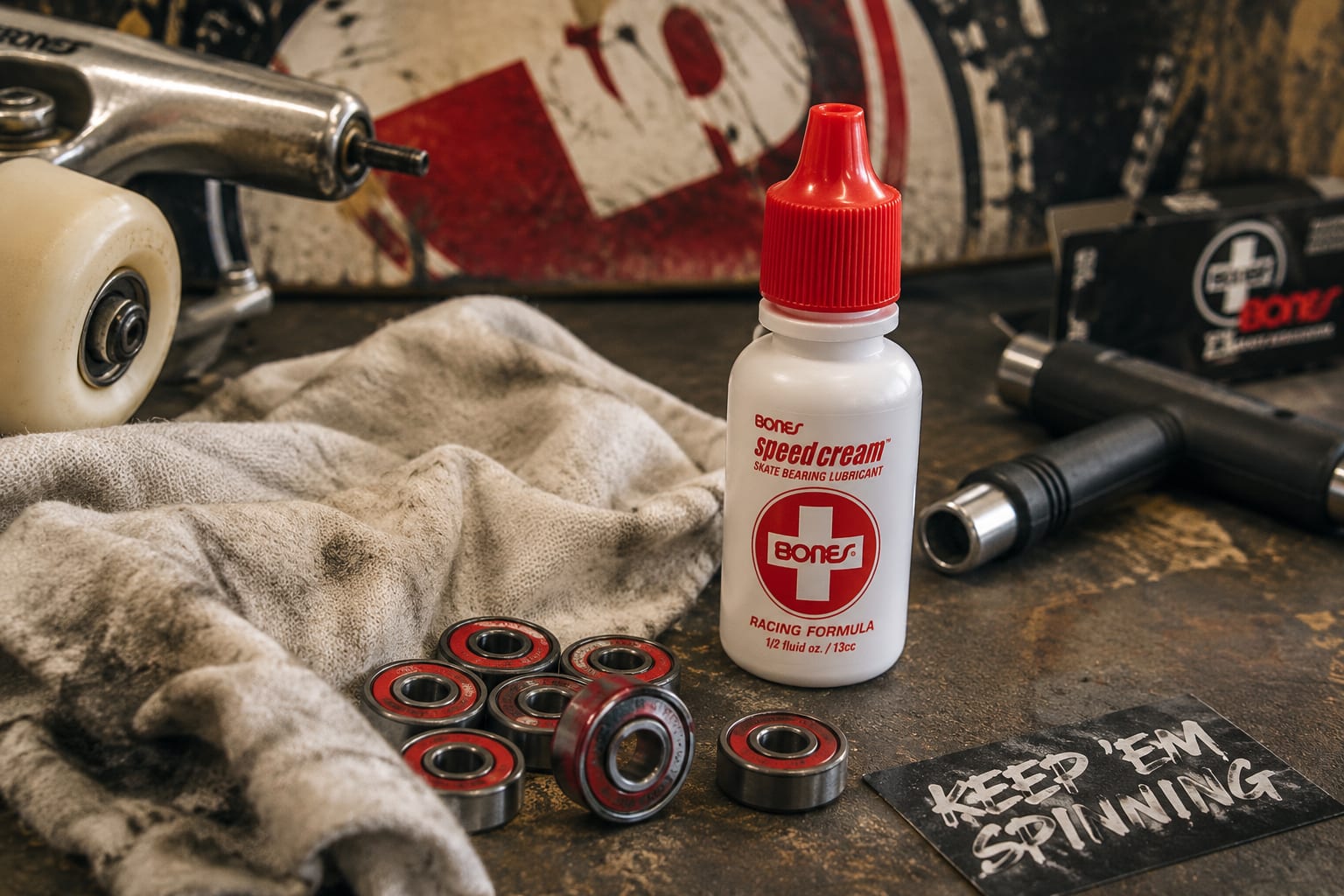
If your bearings squeak, sound odd when they roll, or the board feels much slower than it used to, you probably don’t need new ones: you need to clean them. Bearing maintenance is one of the cheapest ways to make your skateboard last longer. It takes about 30 minutes and roughly doubles the life of a good set.
In this tutorial: what you need, the steps, and the mistakes to avoid.
What you need
- Solvent: 99% isopropyl alcohol, the kind you buy at a pharmacy. About 5€ a litre, enough for 30+ cleanings.
- Lubricant: Bones Speed Cream (10-15€) or sewing machine oil (3€).
- A small container: an empty jam jar with a lid. Don’t use plastic for the alcohol, it can crack it.
- A lint-free cloth: microfibre or gauze.
- Compressed air (optional): a can of the kind used to clean PCs. About 5€.
- Skate tool: to take the wheels off.
- A needle, pin or similar: to pop the shields out without damaging them.
Step by step
1. Take the wheels off and pull the bearings out
- Remove the 4 wheels from the board with the skate tool (loosen the axle nut).
- To pull the bearings out of each wheel, use the truck axle as a lever:
- Push the wheel onto the axle until the bearing touches the end.
- Tilt the wheel sideways to pry against it.
- The bearing pops out.
- Repeat for all 8 bearings (2 per wheel).
2. Remove the shields
Each bearing has a shield (cover) on each side. There are two types:
- Black rubber shields (most of them): lift them out carefully with a needle. Slide the tip between the shield and the outer ring and lift gently. It comes out in one piece.
- Metal shields with a retaining ring (Swiss): take out the C-ring first (with the needle), then the metal shield lifts off.
Shortcut: if you only open ONE side (leave one shield on), you save half the work and the bearing still gets fairly clean. For a deep clean, remove both shields.
3. Soak them in alcohol and shake
- Put the 8 bearings in the jar.
- Fill it with alcohol until they are covered.
- Close the lid and shake for 30-60 seconds.
- The alcohol will turn brown or black: that is the dirt and old lubricant coming out.
- Change the alcohol and repeat if it is still very dirty.
4. Dry them COMPLETELY
This matters a lot: if you lubricate with moisture still inside, the bearings rust within a month.
- Take the bearings out of the alcohol with tweezers, or tip them out.
- Rest them on a microfibre cloth.
- Compressed air blows out the leftover alcohol: aim the jet at the centre of each bearing and spin them.
- If you don’t have compressed air, let them air dry somewhere dry for 30-60 minutes.
- Before lubricating: spin each bearing with your fingers. If it spins freely and silently, it is ready. If it spins with resistance or makes noise, it is still damp.
5. Apply the lubricant
- 2-3 drops of Speed Cream (or equivalent oil) per bearing.
- Put it directly on the balls, in the centre.
- Spin the bearing about 30 times with a finger to spread it.
Don’t overdo the lube. More is not better: the excess attracts dust and ends up slowing the bearing down.
6. Put the shields back
Position the shield (with the C-ring first if it is a Swiss bearing) and press gently around the edge until it seats. Don’t force it: if it doesn’t go in easily, it is not lined up.
7. Reinstall in the wheels and rebuild the board
- Push a clean bearing into each side of the wheel (you can use the axle as a guide: put a bearing on the axle, fit the wheel on top and press).
- Recommended: fit a spacer between the two bearings. If you didn’t have any, now is a good time to buy them (3-5€).
- Put the wheels back on the trucks.
- Tighten the nuts until the wheel spins freely with a flick but has no side play.
When to replace instead of clean
Even a good cleaning doesn’t save everything. Replace your bearings when:
- Rust spots appear that don’t come off with cleaning.
- The balls make a metallic noise when you spin the bearing loose (they are damaged).
- The bearing catches at certain points of its rotation.
- The inside spins with play (an unbalanced bearing).
A new set of Bones Reds costs 18-25€. If you spend 30 minutes cleaning and see no improvement, it is not worth trying further.
Preventive maintenance (before they fail)
The most efficient routine:
- Every 6-12 months: full cleaning and relubrication.
- After any session on wet or very dusty ground: wipe the wheels and, if the bearings crunch, do a full cleaning.
- Every 1-2 months: rotate the wheels to even out the wear.
- Always: keep spacers in.
With this minimum of care, a set of Bones Reds (25€) lasts 5+ years. Without maintenance, 2 to 3 years at most.
Where to go next
- Complete guide to Bones bearings: to work out which model suits you.
- How to build a complete skateboard: the whole assembly process.
- How to choose wheels: the other component that goes with the bearings.
Frequently asked questions
How often should I clean my bearings?
It depends on how much you skate. Daily outdoor skaters: every 6 months. Two or three sessions a week: every 12 months. Occasional cruising: every 18 to 24 months. If you rolled through water or very dusty ground, clean them the same day.
What solvent can I use to clean them?
99% isopropyl alcohol (you can find it at a pharmacy, around 5€ a bottle). Acetone also works but it is harsher and can eat the rubber shields. Bones sells its own Bearing Cleaner, but alcohol works almost the same.
And what do I use to lube them afterwards?
Bones Speed Cream is the standard (10-15€, it lasts years). Alternatives are sewing machine oil, Tri-Flow oil and WD-40 Specialist Dry Lube. Avoid regular WD-40: it is a solvent, not a lubricant.
Can I clean bearings without taking them apart?
Yes, but it cleans less. Soaking the whole bearing (shields on) in alcohol and shaking it is fine for light maintenance. For a deep clean you have to remove the shields.
How long do clean bearings last compared to uncleaned ones?
Roughly twice as long. Well-maintained Bones Reds last 4 to 6 years. Without maintenance, 2 to 3. For Swiss or ceramic bearings the difference is smaller but still real (from 8 years down to 5 without maintenance).
Conversation
Your name will be public. Your email stays private. Comments are reviewed before publishing.